These records are found in the online catalog of The Mariners’ Museum and Park in Newport News, Virginia. Uncurated search results are presented to give researchers and interested readers an idea of whether the museum’s archives contain information about this vessel and whether it may be worthwhile to visit the museum’s catalog search page for further investigation. Uncurated results may be inaccurate or incomplete.
Mariners Museum online catalog search, July 12, 2026. Search phrase: "Jeff". Catalog returned 81 records; this selection table includes 81 records fetched through catalog result pages.
Use these buttons to send uncurated search results to your own app or text document for further research. First, check the box for any row, or click "Select All" then uncheck any rows. Then click "Show Selections". You can then copy your selections from the text box and past them into your app.
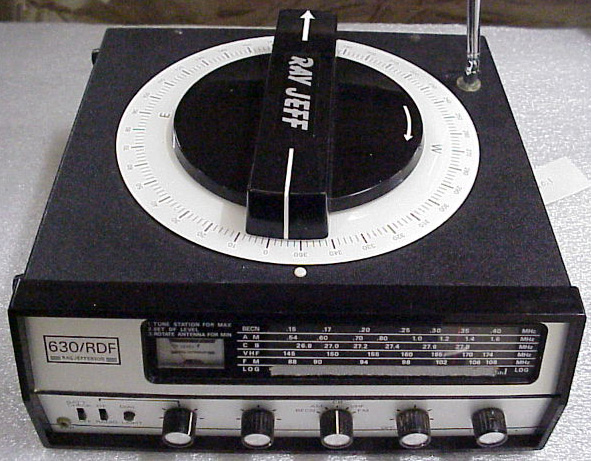
SHORT DESCRIPTION: Simple, portable radio direction finder, made in Japan for Ray Jefferson, in its original cardboard packing. NOTES: Manufacturer: Ray Jefferson Model No. 630 Ser No. J1805 Size: 12" x 12" x 5" Voltage: 12V DC Bands VHS, CB, AM, FM, Beacon Misc.: In original carton
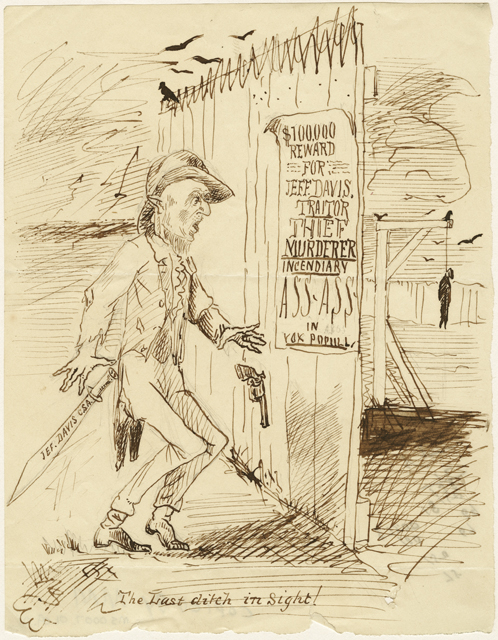
Jeff Davis Piracy cases : - full report of the trial of William Smith for piracy, as one of the crew of the confederate privateer, the Jeff Davis : before Judges Grier and Cadwalader, in the Circuit Court of the United States, for the Eastern District of Pennsylvania, held at Philadelphia, in October, 1861 - by D.F. Murphy.
United States–History–Antiquities–Civil War, 1861-1865–Photographs.
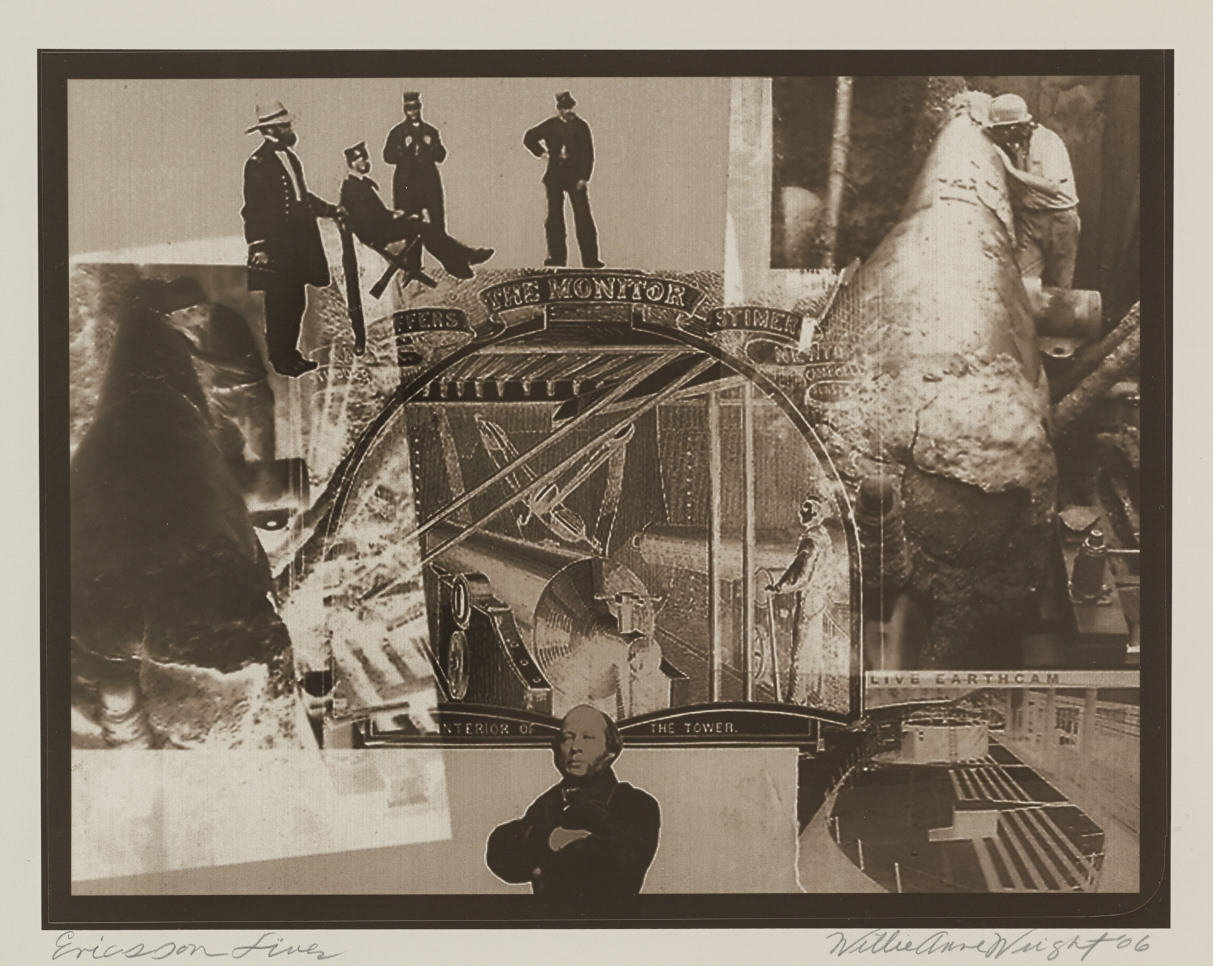
Pencil manuscript written by artist recto on print: "Ericsson Lives Willie Anne Wright '06" Pencil manuscript written by artist verso on mat:"Ericsson Lives"
Ordnance, Naval.; Turrets.; Armored vessels.
Composite photograph with contemporary and historical images of the Monitor. Features images of Jeff Johnston of the Monitor National Marine Sanctuary kissing Monitor's Dahlgren gun, Ericsson, Monitor officers, an 1862 illustration of the turret, and the Monitor replica at The Mariners' Museum.
Overall view roller skating party in progress given for HRPE enlisted personnel at the Jeff Briar ROller RInk, Newport News, Va., where photo was taken. Picture made for publicity purposes.
Part of entertainment furnished for the HRPE enlisted personnel roller skating party at Jeff Briar Rink, Newport News, Va., consisted of acrobat and trick skating as shown. Picture was made for publicity purposes.
NORTHROP GRUMMAN NEWPORT NEWS, 4101 WASHINGTON AVE. NEWPORT NEWS, VA. 23607, PHOTO REQUEST NO C02-207 82 DATE: 08/09/2002 USS MONITOR TURRET ARRIVAL AT VASCIC CHARGE NO.: X51-271X-2 STAFF PHOTOGRAPHER/S JOHN WHALEN
Turrets.; Hoisting machinery.
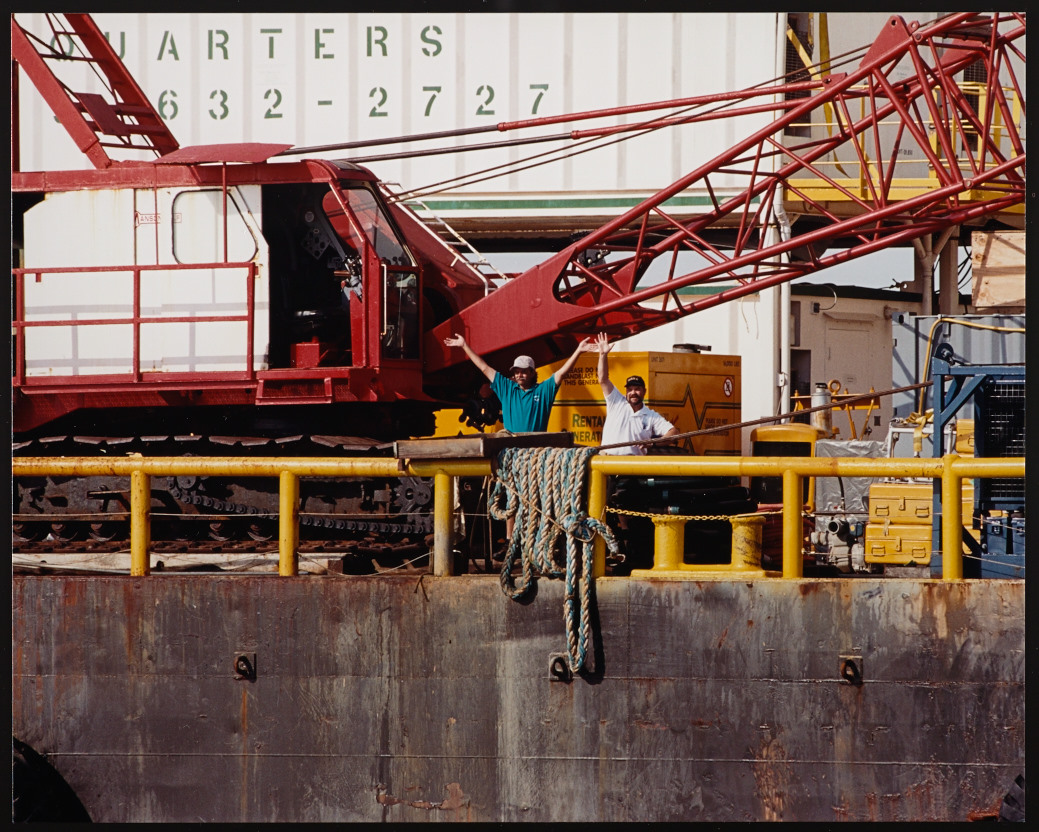
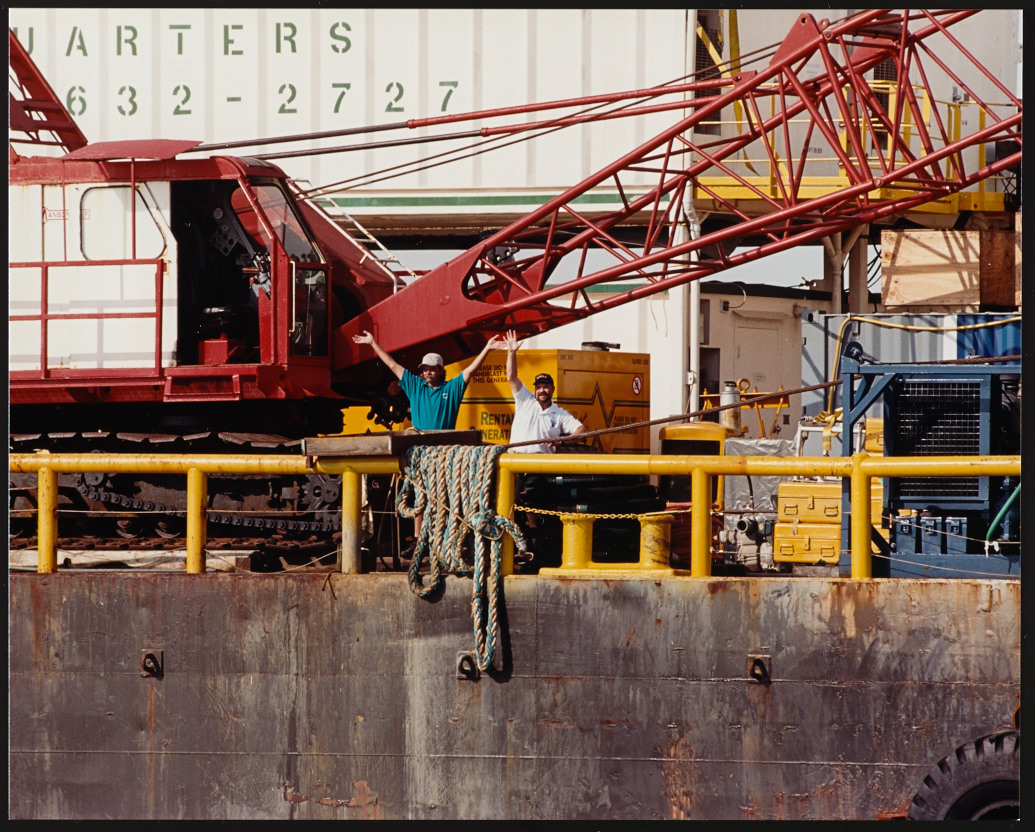
Color photograph of Jeff Johnston (left), historian of the Monitor National Marine Sanctuary, and an unidentified individual (right) standing on the deck of barge Wotan with their hands in the air in a celebratory manner. Restricted access. Kept in remote cold storage; access requires 48 hours advance notice. Patrons are requested to use a vintage duplicate print located in Box 2, available in the Library.
NORTHROP GRUMMAN NEWPORT NEWS, 4101 WASHINGTON AVE. NEWPORT NEWS, VA. 23607, PHOTO REQUEST NO C02-207 82 DATE: 08/09/2002 USS MONITOR TURRET ARRIVAL AT VASCIC CHARGE NO.: X51-271X-2 STAFF PHOTOGRAPHER/S JOHN WHALEN
Turrets.; Hoisting machinery.
Color photograph of Jeff Johnston (left), historian of the Monitor National Marine Sanctuary, and an unidentified individual (right) standing on the deck of barge Wotan with their hands in the air in a celebratory manner.
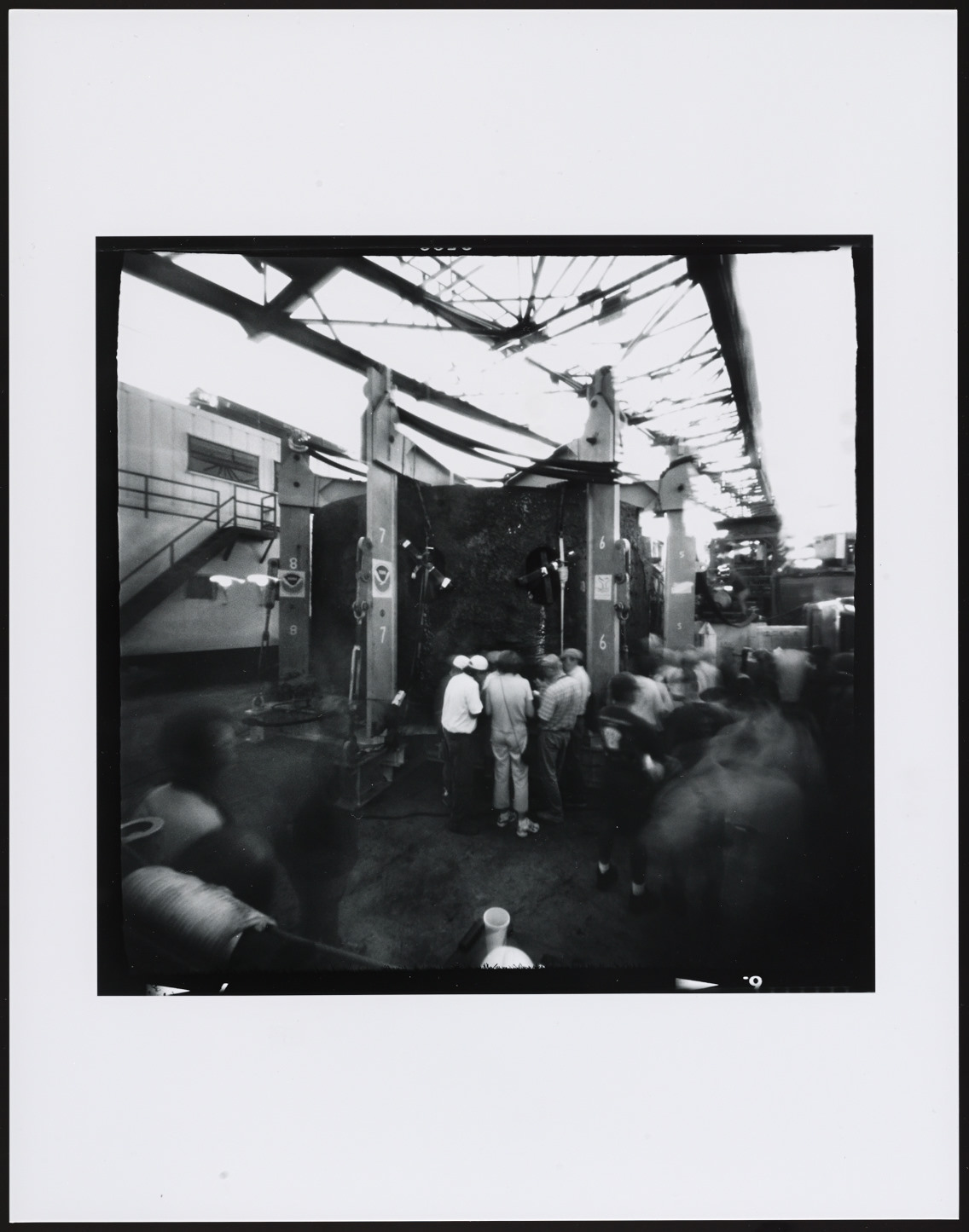
Distant view of a reporter's interview with Jeff Johnston and John Broadwater with a view of the retrieved turret of the USS Monitor after it was brought onto the deck of the derrick barge Wotan on August 5, 2002 off the coast of Cape Hatteras, N.C.
Cpl. Madeline Ferrner, A307414, Johnstown, Pa., HRPE 1st WAC Co., feels none the worse for wear after "Twirl" treatment by two entertainers adding to the fun at the roller skating party at Jeff Briar Rink, Newport News, Va., where photo was taken. Party was given for HRPE enlisted personnel and guests. Picture was made for publicity purposes.
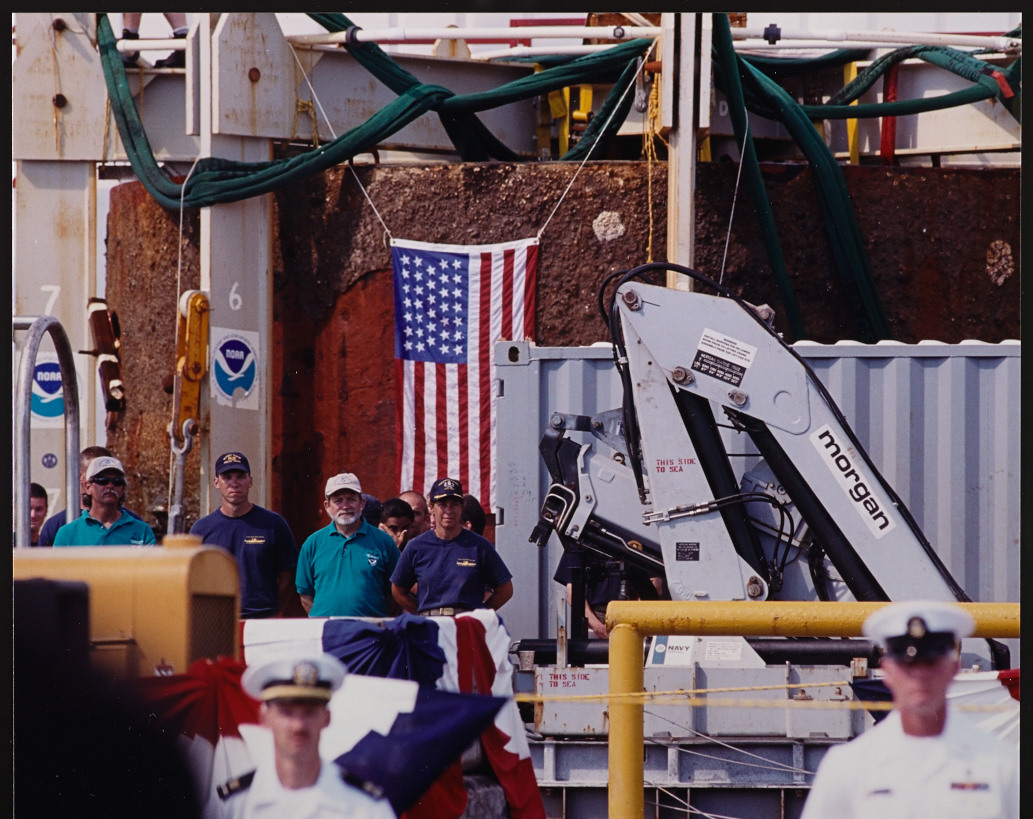
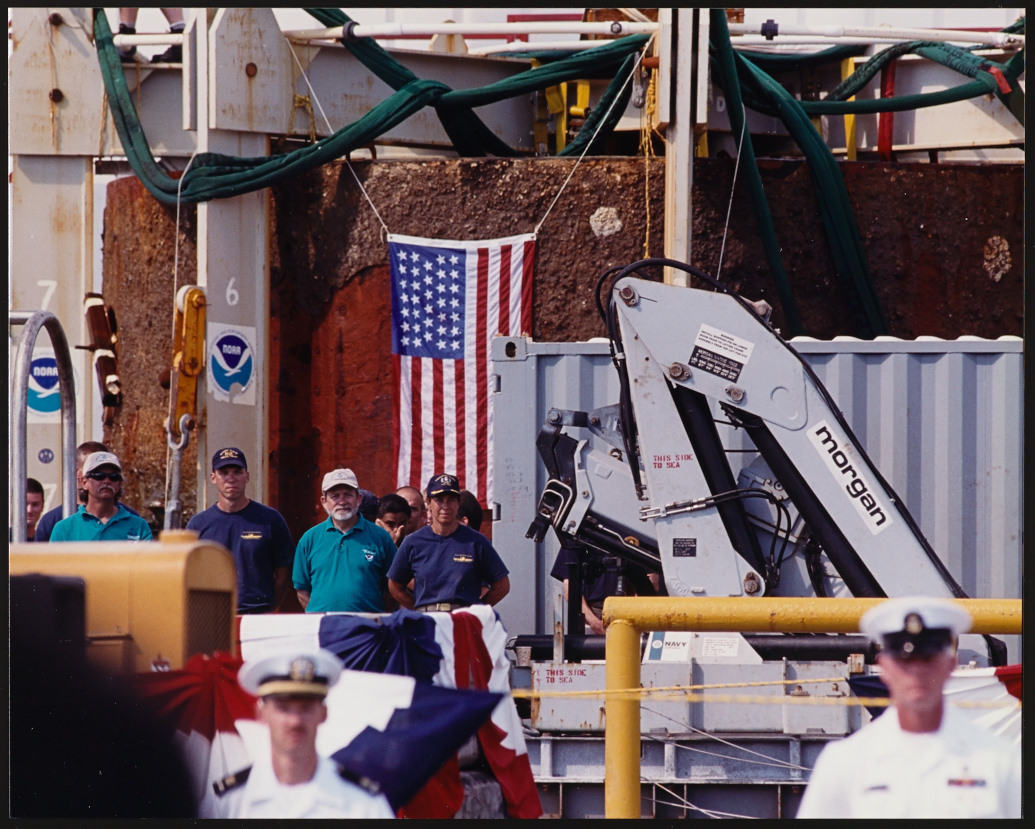
Color photograph of the recovered Monitor turret with the 19th century American flag hanging from it. Several important recovery crew members are standing in front of it including MDSU 2 Cmdr. Bobbie Scholley (far right) and Monitor National Marine Sanctuary personnel Jeff Johnston (far left) and John Broadwater (center right). Restricted access. Kept in remote cold storage; access requires 48 hours advance notice. Patrons are requested to use a vintage duplicate print located in Box 2, available in the Library.
HRPE WAC Cpl. DOROTHY NEWMAN, A120470, PRovidence, R.I., dances the light fantastic with E.C. (Shorty) Cook, Beckley, W.Va., at roller skating party for HRPE enlisted personnel at Jeff Briar Roller Rink, Newport News, Va., where picture was taken. Picture was made for publicity purposes.
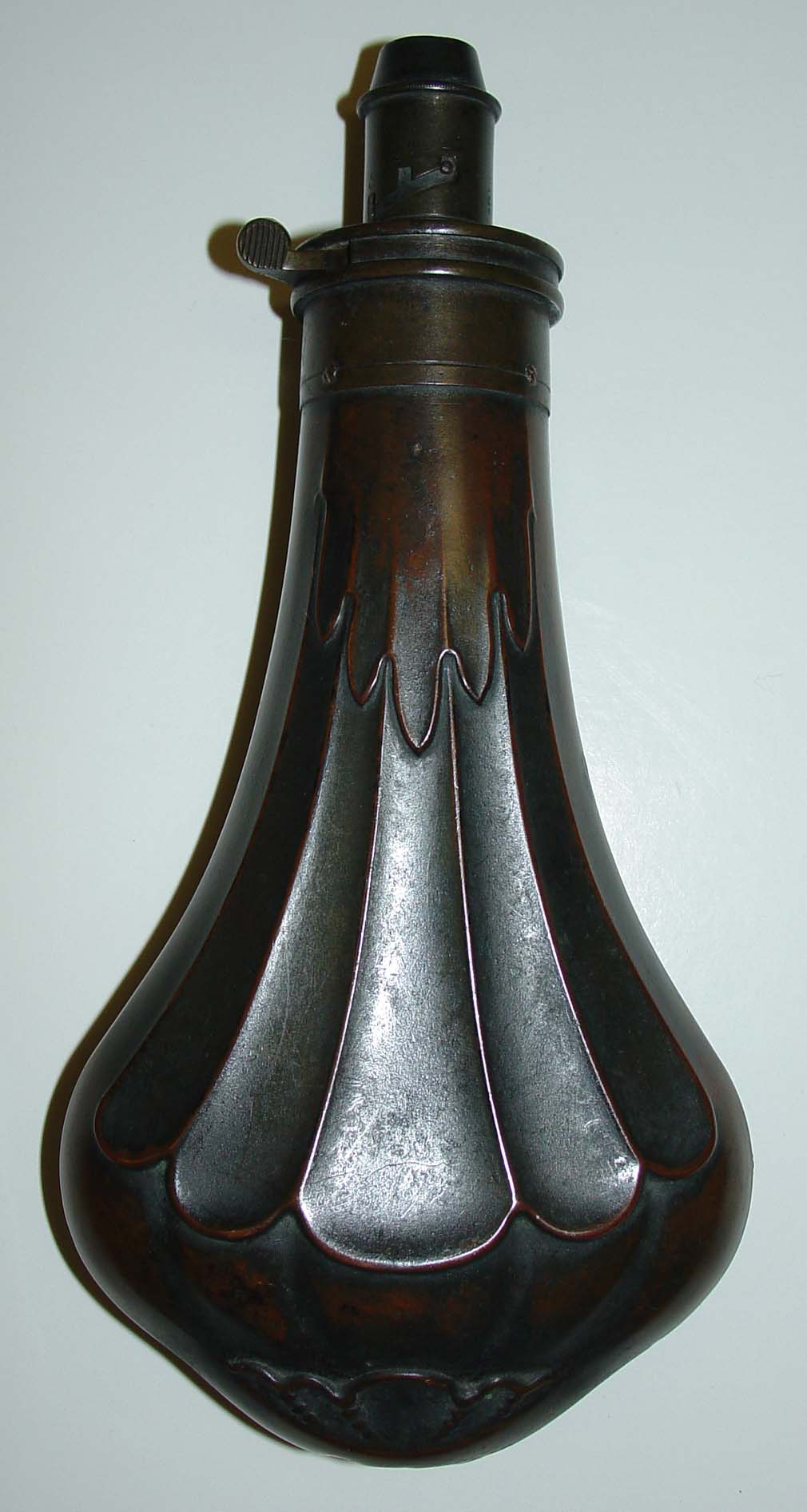
SHORT DESCRIPTION: Brass, civilian type shot container with shot. The container was made by James Barlow & Co of Birmingham. With three stage charger (2-1/2 to 3 drams). NOTES: "Civilian piece", Jeff Johnston, NOAA.
Color photograph of the recovered Monitor turret with the 19th century American flag hanging from it. Several important recovery crew members are standing in front of it including MDSU 2 Cmdr. Bobbie Scholley (far right) and Monitor National Marine Sanctuary personnel Jeff Johnston (far left) and John Broadwater (center right). Restricted access. Kept in remote cold storage; access requires 48 hours advance notice. Patrons are requested to use a vintage duplicate print located in Box 2, available in the Library.
United States–History–Civil War, 1861-1865–Correspondence.; United States–History–Civil War, 1861-1865–Personal narratives, Confederate.
Includes biographical, command and general subject indices, pp. 455-497. "Using personal accounts from more than 270 soldiers, farmers, clerks, surgeons, sailors, chaplains, farm girls, nurses, nuns, merchants, teachers and wives, author Jeff Toalson has created a compilation that is remarkable in its simplicity and stunning in its scope." rear cover.
Global Positioning System.; Artificial satellites in navigation.
Differential GPS explained : - an exposé of the surprisingly simple principles behind today's most advanced positioning technology - by Jeff Hurn for Trimble Navigation
NORTHROP GRUMMAN NEWPORT NEWS, 4101 WASHINGTON AVE. NEWPORT NEWS, VA. 23607, PHOTO REQUEST NO C02-207 21 DATE: 08/09/2002 USS MONITOR TURRET ARRIVAL AT VASCIC CHARGE NO.: X511-271X-2 STAFF PHOTOGRAPHER/S JIM HEMEON
Naval ceremonies, honors, and salutes–Virginia–Newport News–Photographs.; Hoisting machinery.
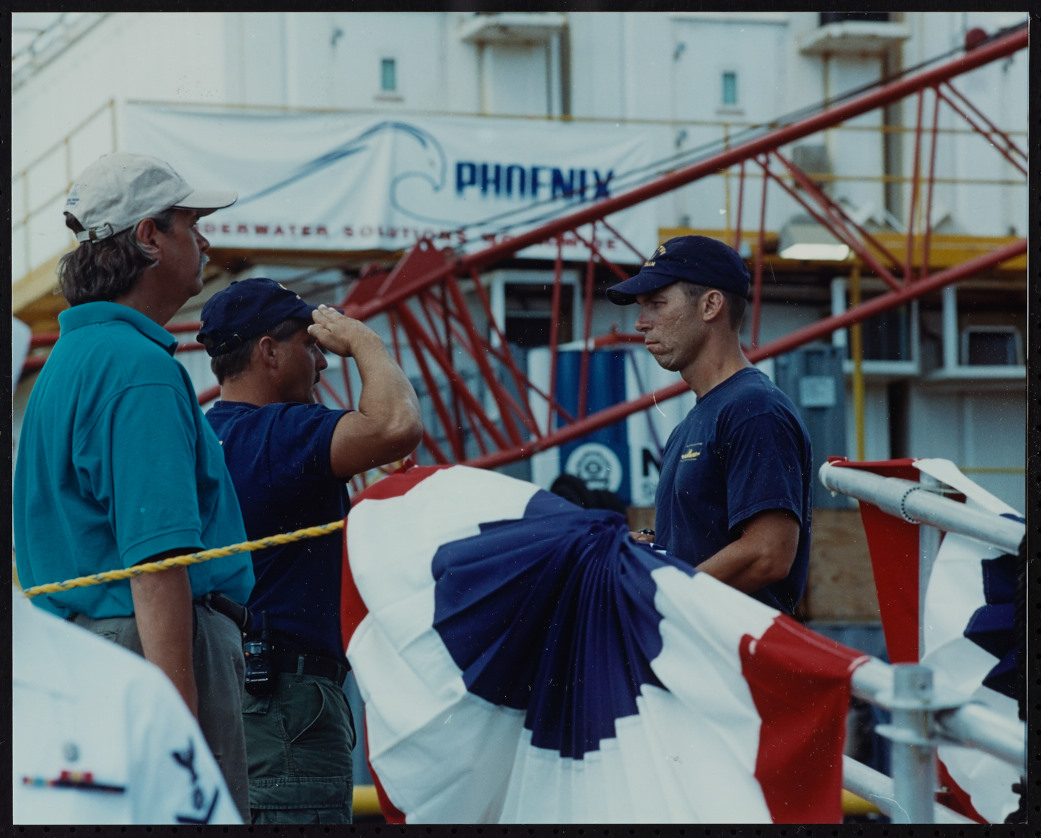
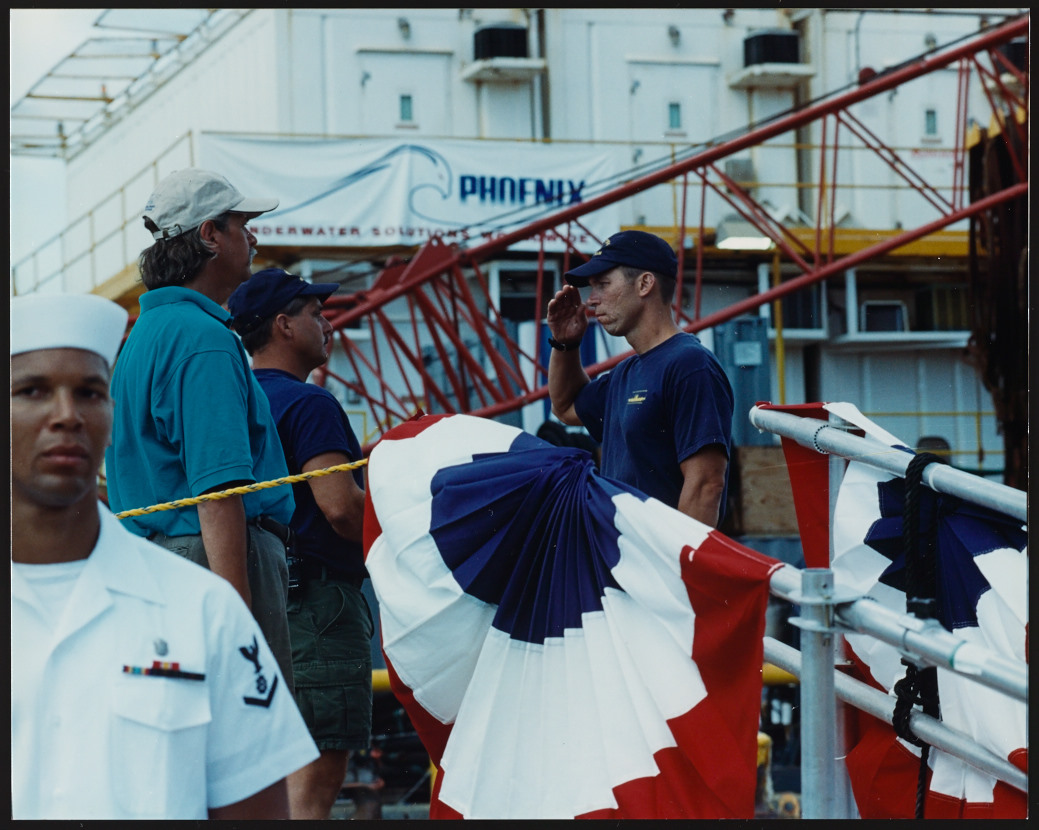
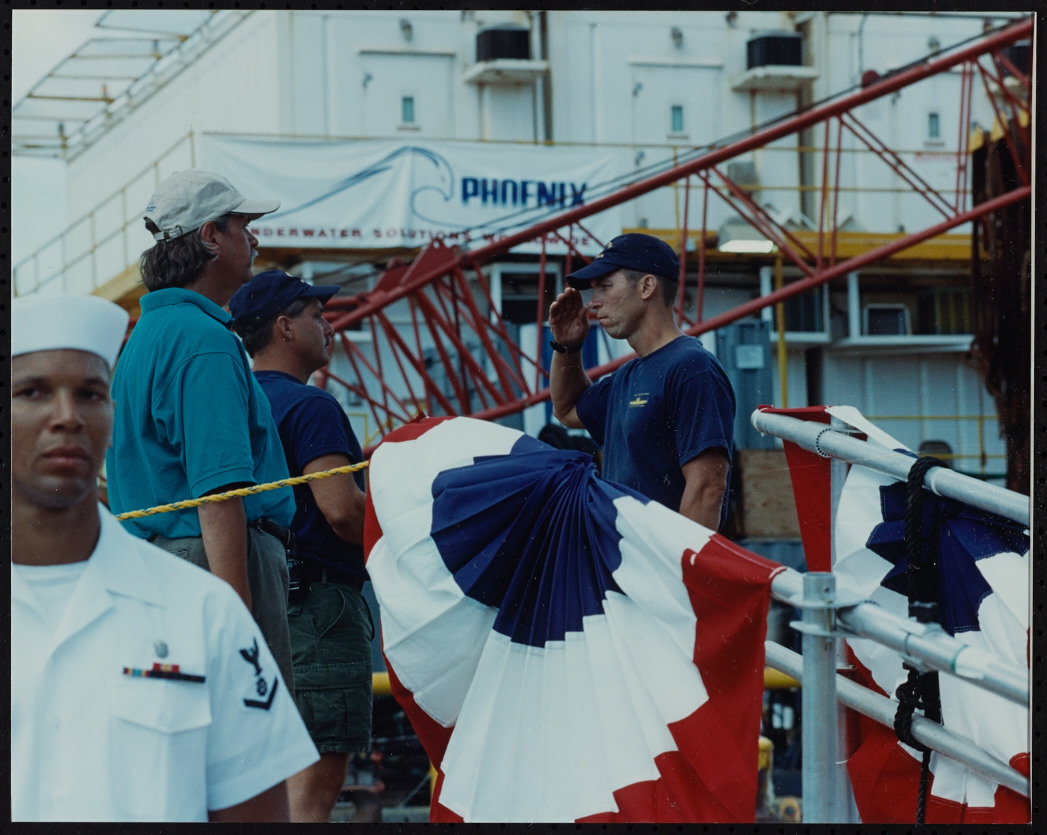
Color photograph of several members of the Monitor recovery crew. One member of Mobile Diving and Salvage Unit (MDSU) 2 is saluting another during the Passing the Flag ceremony transferring the turret from the Navy to NOAA. Jeff Johnston (left), historian of the Monitor National Marine Sanctuary, observes. In the background of the photograph is ship equipment. Restricted access. Kept in remote cold storage; access requires 48 hours advance notice. Patrons are requested to use a vintage duplicate print located in Box 2, available in the Library.
NORTHROP GRUMMAN NEWPORT NEWS, 4101 WASHINGTON AVE. NEWPORT NEWS, VA. 23607, PHOTO REQUEST NO C02-207 20 DATE: 08/09/2002 USS MONITOR TURRET ARRIVAL AT VASCIC CHARGE NO.: X511-271X-2 STAFF PHOTOGRAPHER/S JIM HEMEON
Naval ceremonies, honors, and salutes–Virginia–Newport News–Photographs.; Hoisting machinery.
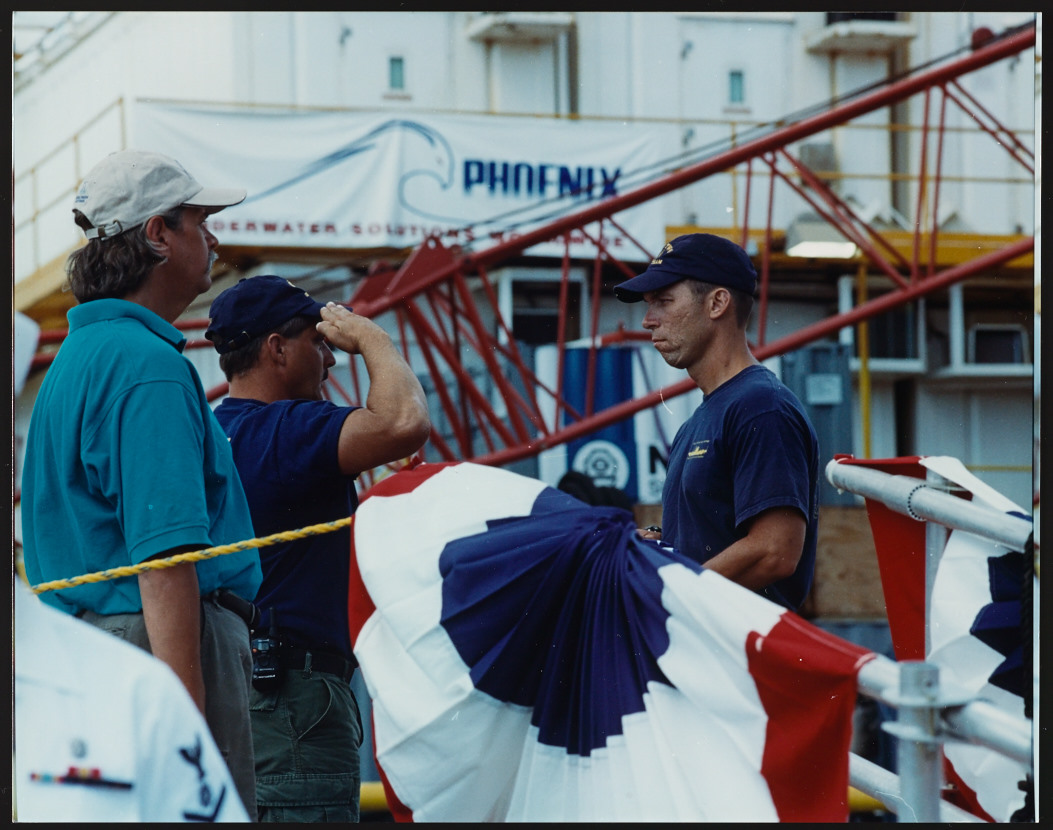
Color photograph of several members of the Monitor recovery crew. One member of Mobile Diving and Salvage Unit (MDSU) 2 salutes another during the Passing the Flag ceremony transferring the turret from the Navy to NOAA. Jeff Johnston (left), historian of the Monitor National Marine Sanctuary, observes. The background depicts equipment on deck of Wotan.
Reenlist - Maj. Gilbert C. Madison, 0343941, Camp Adjutant, from Galesburg, Ill. swears in the largest group of reenlistees so far to reenter the Army at a special ceremony at post headquarters, 26, Oct. 1945. The men are left to right, first row: T/Sgt. Jeff D. Young, 6388522, 471st. ASF Band, Houston, Texas; T/Sgt. Alfred M. Richards, 20810908. Co C. Sta Svc, Garrison, Texas; S/Sgt. Louis Gonzalez, 6776668, Co C Sta Svc, Hempstead, L.I. N.Y., Sgt. Henry C. Wood, 18117346, 471st ASF Band, Palestine, Texas; and Sgt. Robert J. Schmidt, 32822127, Det 1 PW Cp. Bronx, N.Y. Second Row: Cpl. Ronald G. Richardson, 36722343, Co A Sta Avc, Evanston, Ill. T/5 Willie Ramey 35923210, Co E. Mess Svc, Ausier, KY.; T/5 Johnny E. Ruse, 35093199, 3782nd Truck Co, Kokomo, Ind, T/5 Lee Dell Tripp 34589866, 3782nd QM Truck Co., Pisgah, Ala. and Pfc. Joseph Orris, 33583284, Co A Sta Svc, Philadelphia, PA. Third Row Pfc. Carroll B. Smith, 38217350, 1329th, Midland, Texas; Pfc. Willard A Owens, 35643415, Co H. Mess Svc, Sassfras, KY.; Pfc. Anthony M. Romano, 32402710, Co G Mess Svc, Lynbrooky, L.I. N.Y. Pfc. Louis Lexie, 33268003, Co F Mess Svc Daisytown, PA; and Pfc. Robert W. Riley, 32766366, 1329th Spotswood, New Jersey. Fourth row: Pfc. Thomas J. Ginneman, 3355658087, 1329th, Det 1 PW CP, Pasadena, MD. Pfc. Henry P Tozia, 31417340, Co CL Sta Svc, Oxford, Mass.
Military ceremonies, honors, and salutes–Virginia–Newport News.
Group portrait of at least 25 soldiers, they are raising their right hands as they take their oath in an outdoor ceremony.
NORTHROP GRUMMAN NEWPORT NEWS, 4101 WASHINGTON AVE. NEWPORT NEWS, VA. 23607, PHOTO REQUEST NO C02-207 20 DATE: 08/09/2002 USS MONITOR TURRET ARRIVAL AT VASCIC CHARGE NO.: X511-271X-2 STAFF PHOTOGRAPHER/S JIM HEMEON
Naval ceremonies, honors, and salutes–Virginia–Newport News–Photographs.; Hoisting machinery.
Color photograph of several members of the Monitor recovery crew. One member of Mobile Diving and Salvage Unit (MDSU) 2 salutes another during the Passing the Flag ceremony transferring the turret from the Navy to NOAA. Jeff Johnston (left), historian of the Monitor National Marine Sanctuary, observes. The background depicts equipment on deck of Wotan. Restricted access. Kept in remote cold storage; access requires 48 hours advance notice. Patrons are requested to use a vintage duplicate print located in Box 2, available in the Library.
NORTHROP GRUMMAN NEWPORT NEWS, 4101 WASHINGTON AVE. NEWPORT NEWS, VA. 23607, PHOTO REQUEST NO C02-207 21 DATE: 08/09/2002 USS MONITOR TURRET ARRIVAL AT VASCIC CHARGE NO.: X511-271X-2 STAFF PHOTOGRAPHER/S JIM HEMEON
Naval ceremonies, honors, and salutes–Virginia–Newport News–Photographs.; Hoisting machinery.
Color photograph of several members of the Monitor recovery crew. One member of Mobile Diving and Salvage Unit (MDSU) 2 is saluting another during the Passing the Flag ceremony transferring the turret from the Navy to NOAA. Jeff Johnston (left), historian of the Monitor National Marine Sanctuary, observes. In the background of the photograph is ship equipment.
Midway, Battle of, 1942.; World War, 1939-1945–Campaigns–Pacific Ocean.; World War, 1939-1945–Naval operations, American.; Aircraft carriers–United States.
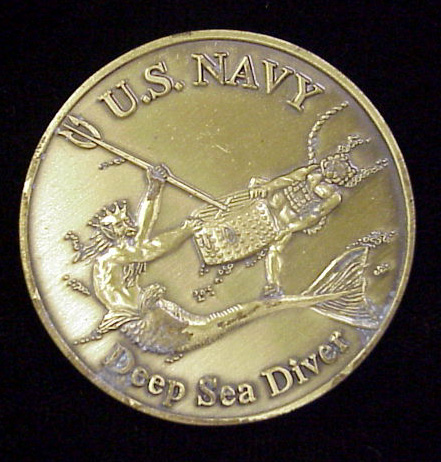
SHORT DESCRIPTION: Commemorative medallion showing Neptune/Poseidon and a U.S. Navy diver wrestling for control of the turret of the U.S.S. Monitor. The reverse shows a profile of the Monitor and has a commemorative inscription. NOTES: Created for the personnel involved in the recovery projects on the U.S.S. Monitor site since 1998. All of the coins were placed in a mesh bag and taken down to the wreck. MNMS and Navy personnel placed a time capsule on the wreck containing fifteen coins, one for each of the "men who still stand watch" (this was done before the discovery of the second individual within the turret). CONDITION NOTES: There is some corrosion scattered across the surface of the coin that is related to the time it spent on the ocean floor. This corrosion, which is not active, should not be removed. NOTES: King Neptune was a Roman god and king of the sea who married Amphitrite and they had a son named Triton who was half man and half fish. The picture on the medallion shows a mix of symbolism for both Neptune/Poseidon (not a fish) and Triton (not a king).
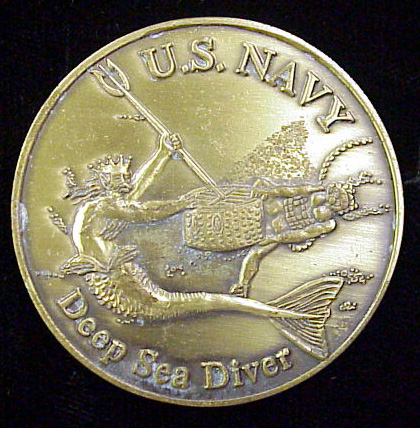
SHORT DESCRIPTION: Commemorative medallion showing King Triton and a U.S. Navy diver wrestling for control of the turret of the U.S.S. Monitor. The reverse shows a profile of the Monitor and has a commemorative inscription. NOTES: Created for the personnel involved in the recovery projects on the U.S.S. Monitor site since 1998. All of the coins were placed in a mesh bag and taken down to the wreck. MNMS and Navy personnel placed a time capsule on the wreck containing fifteen coins, one for each of the "men who still stand watch" (this was done before the discovery of the second individual within the turret). CONDITION NOTES: There is some corrosion scattered across the surface of the coin that is related to the time it spent on the ocean floor. This corrosion, which is not active, should not be removed.
Boats and boating–Exhibitions.; Boatbuilding–Exhibitions.
This exhibit offers a new look at an old trade by showing watercraft in ways that draw attention to their shape and elegance. Photographed during exhibition of the same name, publication includes over 20 color plates with text glorifying the shape, line and sculptural quality of small watercraft.
UNITED STATES - Manufacturer; HONDURAS - Manufacturer
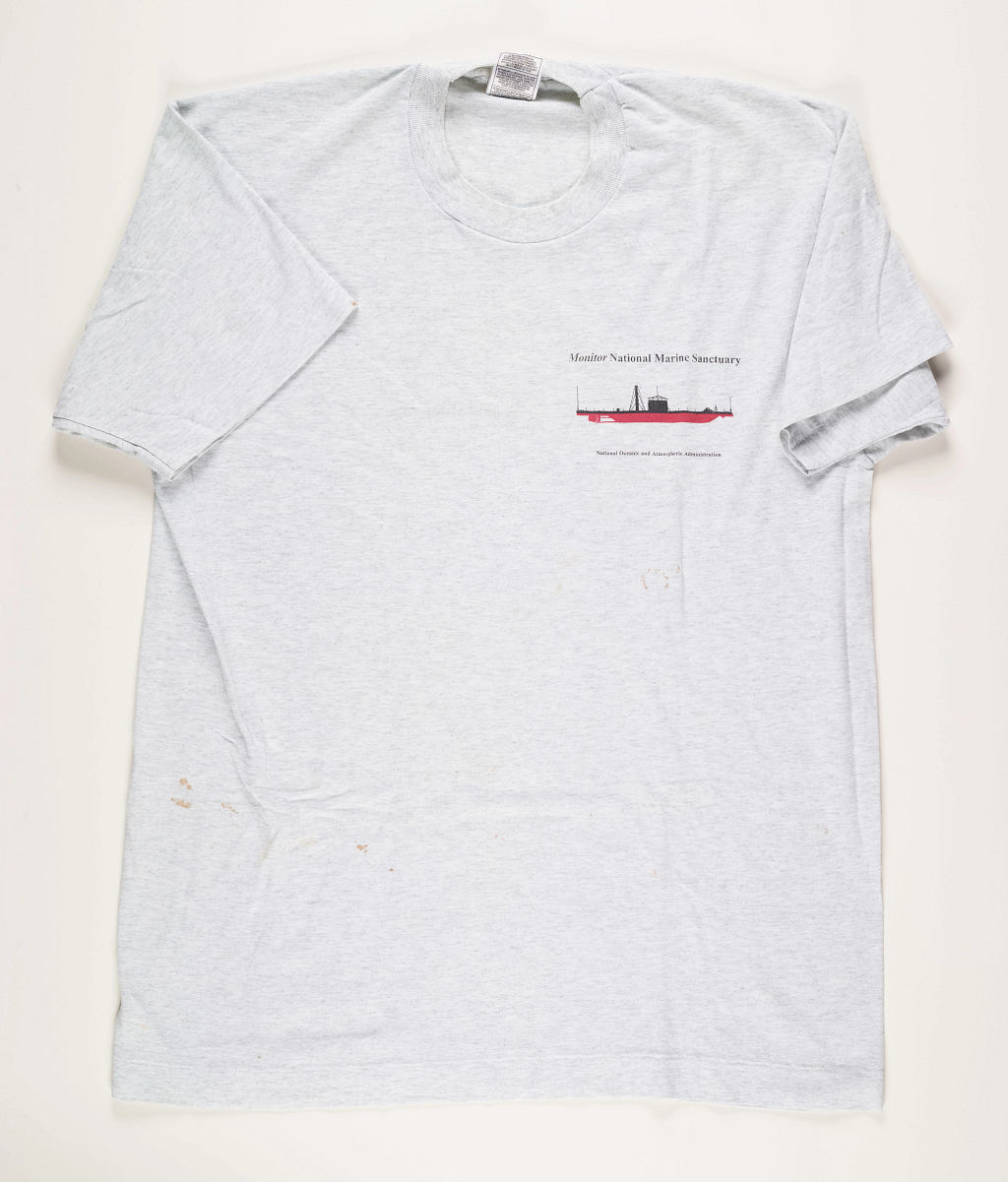
SHORT DESCRIPTION: Light gray t-shirt with a starboard broadside image of USS Monitor with red hull and black superstructure. The text 'Monitor National Marine Sanctuary' is above the image and the text 'National Oceanic and Atmospheric Administration' is underneath. On the back is an image of the wreck with the text 'Monitor National Marine Sanctuary, LASER SURVEY, Line Scanner, June, 1997' over top. Underneath the image is the NOAA logo. There is a tag in the collar that indicates the shirt was manufactured by Fruit of the Loom, BEST trademark, made of 50% cotton and 50% polyester, size large, that the fabric was made in the United States but the shirt was assembled in Honduras. NOTES: This t-shirt relates to the June 11-15, 1997 expedition conducted by the NOAA ship Ferrel. The expedition conducted another laser line-scanning survey of Monitor. This survey used a towed-sensor built by Northrop Grumman Oceanic Systems. It was operated by Science Applications International Corporation (SAIC). The NOAA ship Ferrel supported the mission. The laser system was operated by Jeff Chu, of Northrop Grumman, and Jan Vlcek of SAIC was in charge of overall towing operations. Bad weather and subsurface currents prevented obtaining suitable imagery of the Monitor's hull. NOTES: This collection of t-shirts, polo shirts and hats was compiled by Dr. John D. Broadwater over the course of his work with the various companies and institutions that helped explore and eventually recover parts of the USS Monitor wreck from the floor of the ocean off Nags Head, North Carolina. ADDITIONAL INFORMATION: SEE: USS Monitor: A Historic Ship Completes Its Final Voyage, by John D. Broadwater, pages 135. VESSEL INFORMATION- VESSEL NAME: FERREL (S 492) VESSEL TYPE: Hydrographic Survey Ship BUILDER: ZIGLER SHIPYARDS BUILDER LOCATION: JENNINGS, LOUISIANA BUILD DATE: 1967-1968 VESSEL HISTORY: Originally built for the United States Coast and Geodetic Survey which operated the vessel between 1968-1970. She became part of the NOAA fleet on October 3, 1970.
Liberty Weekend, 1986; Statue of Liberty (New York, N.Y.)–Centennial celebrations, etc; Naval ceremonies, honors, and salutes–New York (State)–New York; Harbors–New York (State)–New York.
Cover title. "Editors ... Jeff Hilton ... Timothy J. Shipman" P. 52.
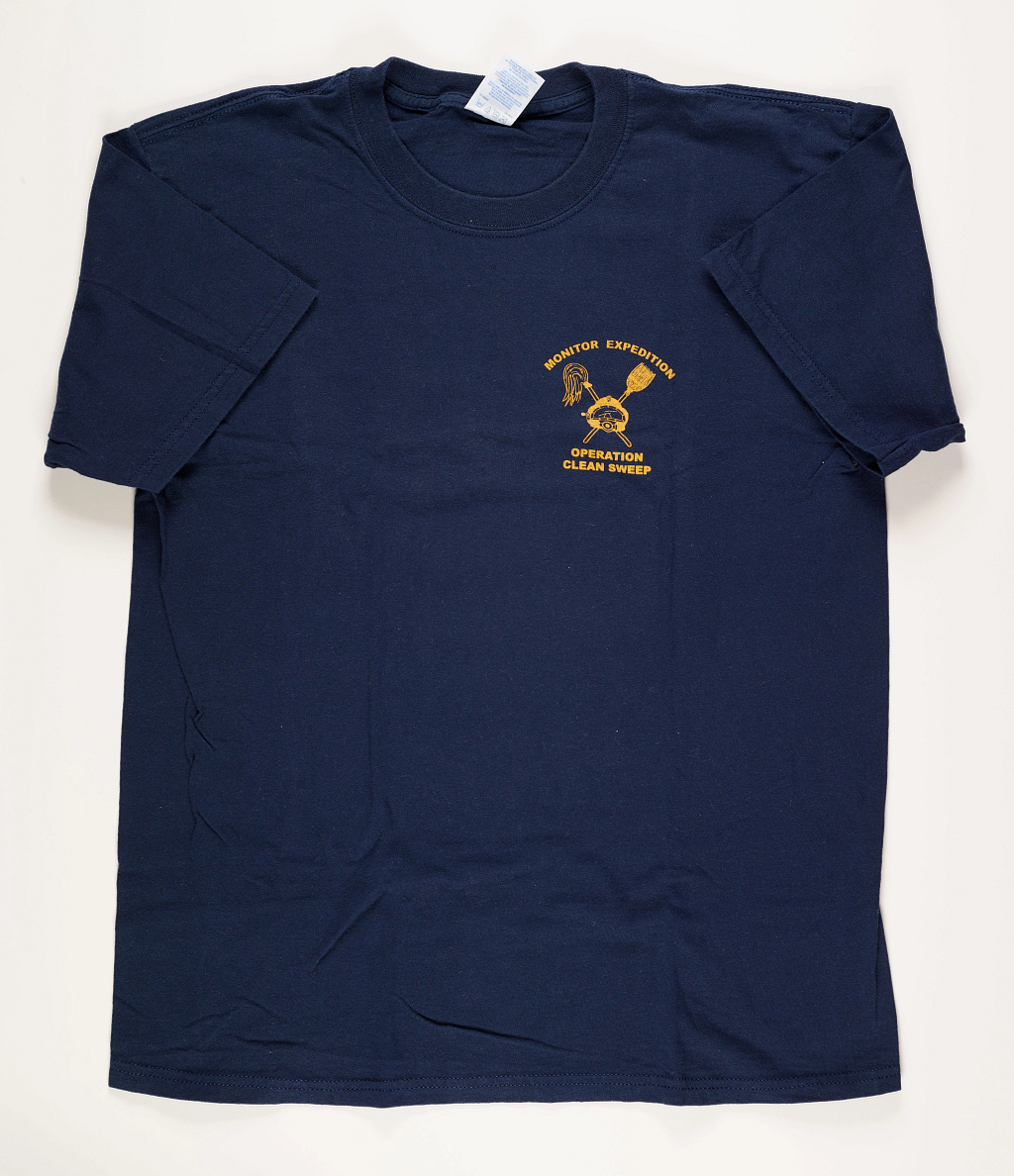
SHORT DESCRIPTION: Navy blue t-shirt. On the front is a divers mask with a crossed broom and mop behind it. The text 'Monitor Expedition' is above and 'Operation Clean Sweep' is below. On the back is a diver directing an octopus, which is wearing a sailor's hat and holding cleaning supplies in his tentacles. The text 'Monitor Expedition 2004' is above and the text 'Operation Clean Sweep', (USS Grasp, MDSU TWO, NOAA)' is below. There is a tag in the collar that indicates the shirt was made or retailed by Gildan Activewear, sized large, made of 100% cotton in Honduras. NOTES: This shirt relates to the June 15-30, 2004 expedition by NOAA, USS Grasp, and MDSU TWO called 'Operation Clean Sweep'. Surface-supplied Navy divers operating from the USS Grasp worked with NOAA archaeologists and historians to assess the condition of the wreck following the 2002 turret recovery operation and Hurricane Isabel, which caused severe damage to nearby Cape Hatteras, North Carolina, in September 2003. During the two-week mission the NOAA-Navy team explored the Monitor’s pilot house; examined the remaining machinery used to rotate the gun turret; cleaned up some of the Navy's tools and debris that had been left behind in 2002; rearranged some of the loose Monitor armor plates and debris into more orderly configurations; and recovered artifacts uncovered by tidal forces associated with Hurricane Isabel. Excerpts of a newspaper article by Mark St. John Erickson dated July 8, 2004: the expedition discovered unexpected deterioration at the wrecksite. A large section of the historic USS Monitor has been "obliterated" by unknown causes according to archaeologists. Navy divers discovered that a significant number of iron plates have been stripped from the upside-down hull, leaving its boilers and galley fully exposed to the damaging currents. Adjacent to this gaping wound, a critical structural member known as the midships bulkhead appears to have collapsed, setting the scene for future and perhaps accelerated deterioration. Sanctuary historian Jeff Johnston said the damage was discovered when a Navy diver from Mobile Diving and Salvage Unit Two attempted to return a 2002 time capsule that had washed a short distance away from the ship to its former location within the wreck. Climbing up on the vessel's armor belt, he scanned the wreck with his helmet camera, sending a stream of unexpected video footage to the NOAA scientists on board the salvage vessel USS Grasp. Despite the murky conditions on the bottom, additional Navy video showed the hull plates displaced in at least one "big chunk" as well as numerous smaller pieces, leaving a debris field strewn across and away from the vessel. It also revealed that a commercial trawling net had become entangled on the remains of the midships bulkhead. NOTES: This collection of t-shirts, polo shirts and hats was compiled by Dr. John D. Broadwater over the course of his work with the various companies and institutions that helped explore and eventually recover parts of the USS Monitor wreck from the floor of the ocean off Nags Head, North Carolina. ADDITIONAL INFORMATION: SEE: USS Monitor: A Historic Ship Completes Its Final Voyage, by John D. Broadwater.
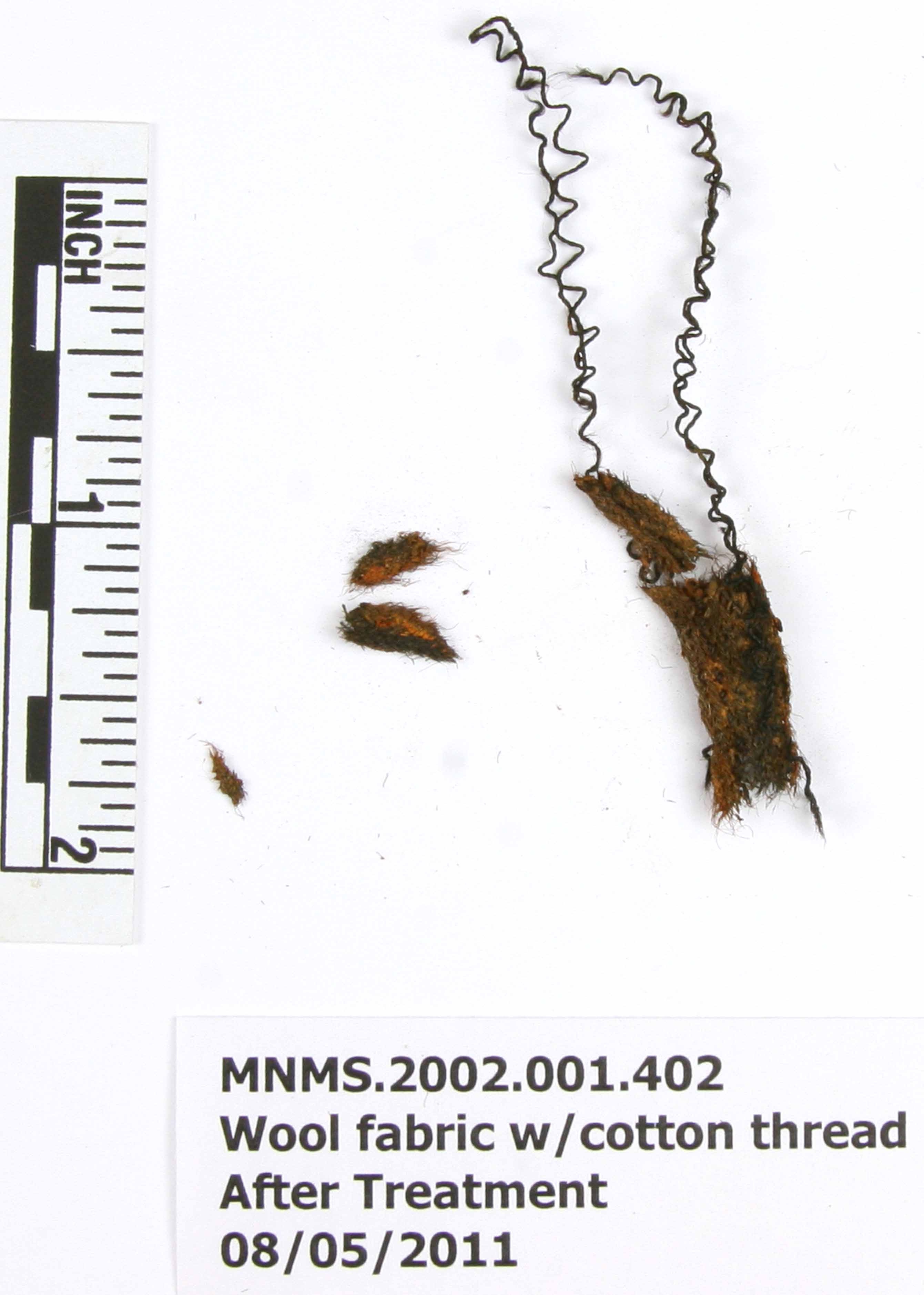
AFTER TREATMENT DESCRIPTION: This accession is a fragment of wool with cotton string attached. The string was recovered by Jeff Johnson in the 6:00 port area of the USS Monitor turret. The string is kinky throughout from being sewn through the wool fabric. The textiles are approximately 1-1/2” wide x 1” deep when laid out straight. The string and wool are in good condition after treatment although very soft and fragile. The wool is brown in color while the string is dark brown in color. PROVENIENCE: USS MONITOR TURRET- Recovered by JJ 6:00 port NOTES: Two threads related to the coat (MNMS.2002.01.262) Threads are from machine stitching and one thread is still attached to a wool fabric fragment. Also related to MNMS.2002-101.01.
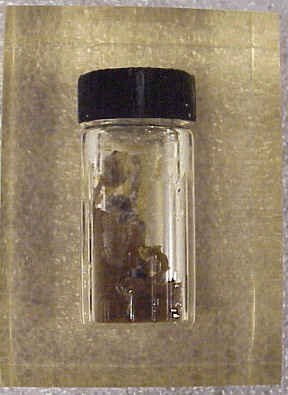
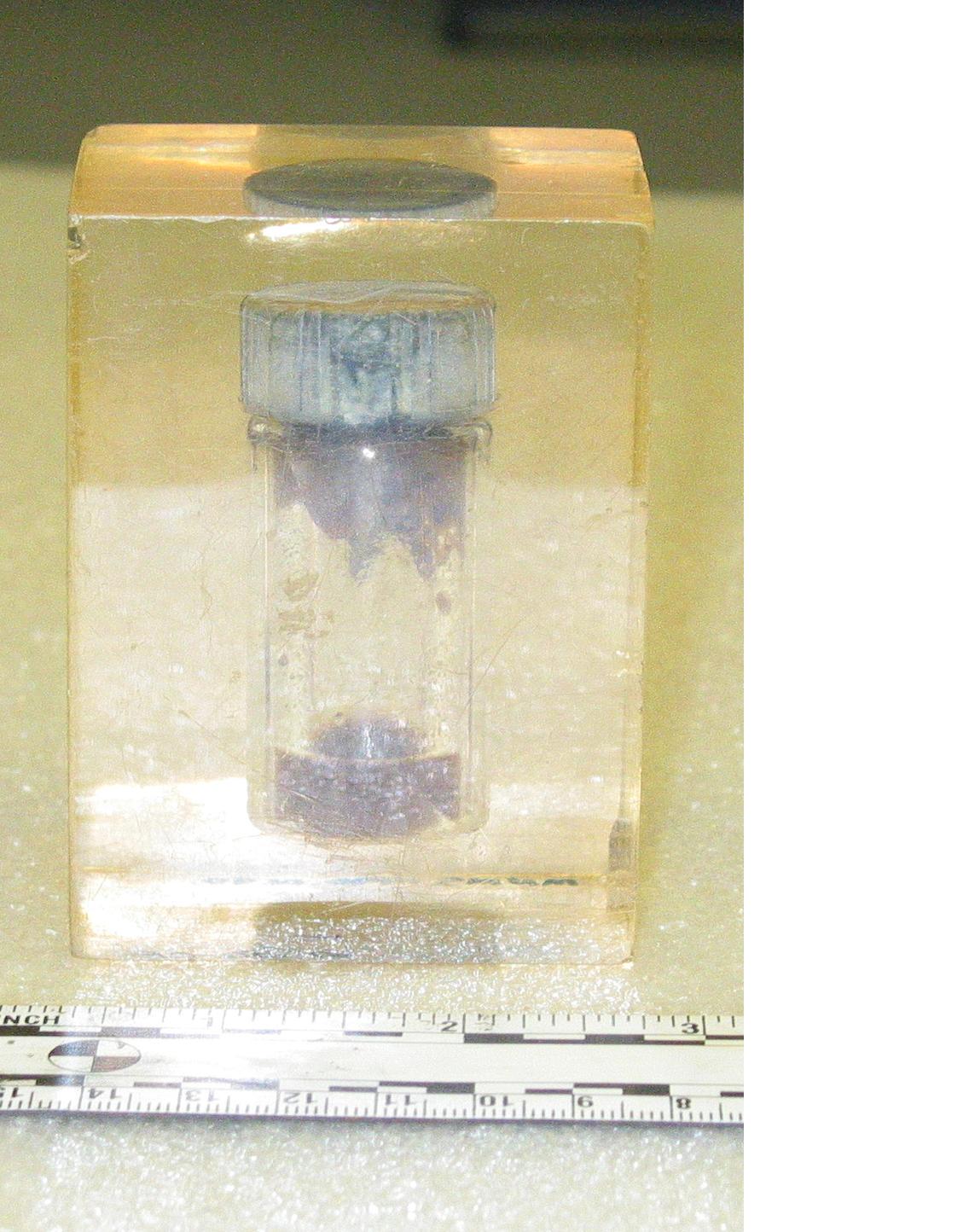
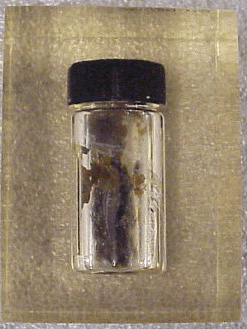
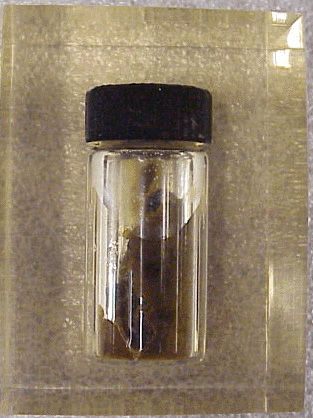
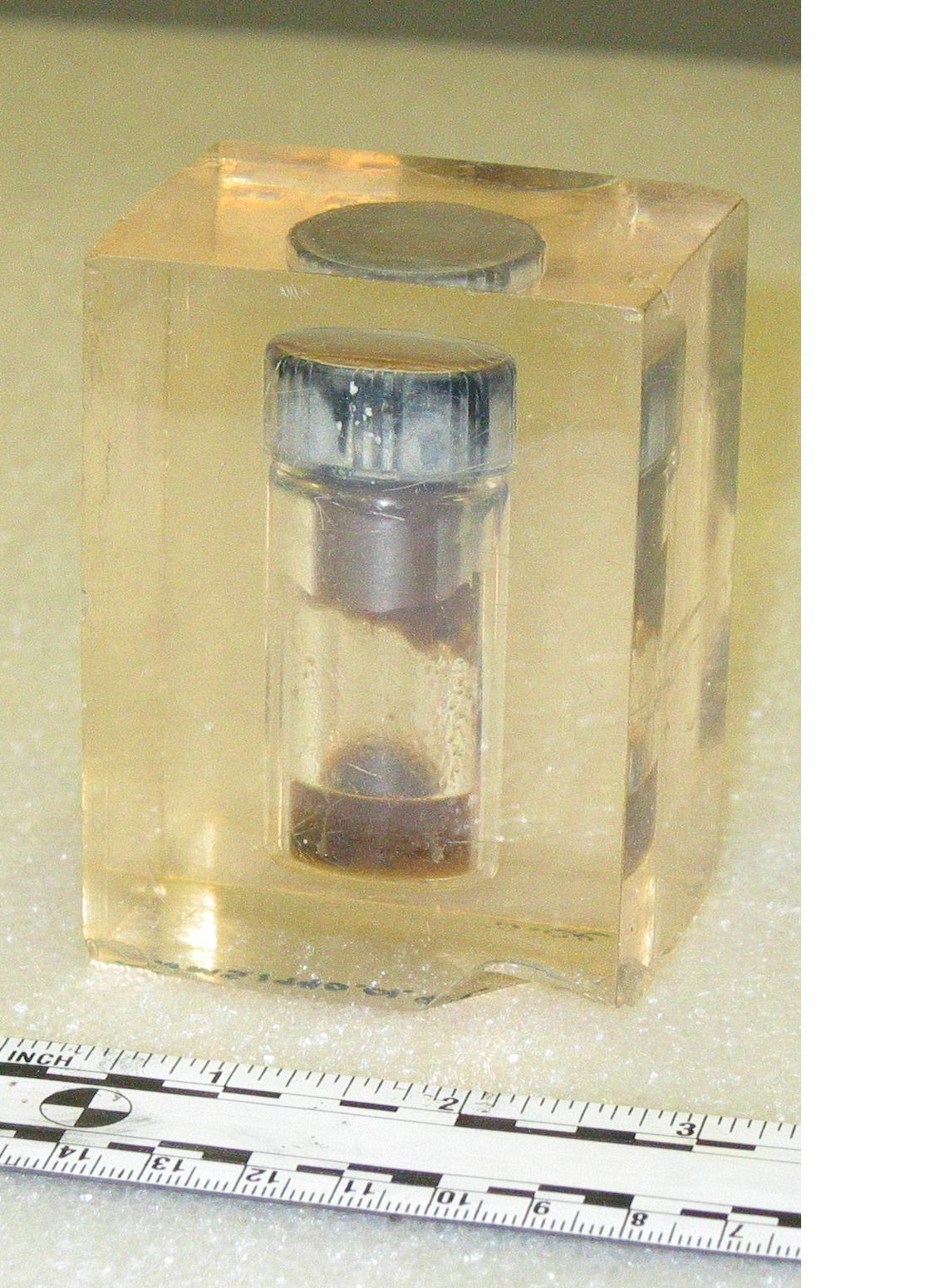
SHORT DESCRIPTION: This accession is for a sample of relish. The relish is stored in a clear, modern glass sample container with a black plastic lid. The container is encased in clear Lucite. NOTES: The sample of pickle relish came from a jar of relish recovered intact from an excavation in the area of the captains cabin in 1979. The relish was in a jar with a glass lid, rubber gasket and wax seal. The lid of the jar is marked "Hartell's Glass Air-Tight Cover." Research in the records of the US patent office reveals that Hartell had patented his air-tight design in 1858. Analysis of the relish indicated that it contained cloves, onions, pepper seeds, cucumbers, mustard seeds, peppercorns and mushrooms. [Dina Hill and Jeff Johnston, NOAA, March 8, 2000] NOTES: Upon further research it is now believed that the relish which is now encased in Lucite is originally from MNMS.1990.001.019. 11/24/2015 MS
WARKWORTH - NEW ZEALAND - Manufacturer; BERMUDA - Related Place
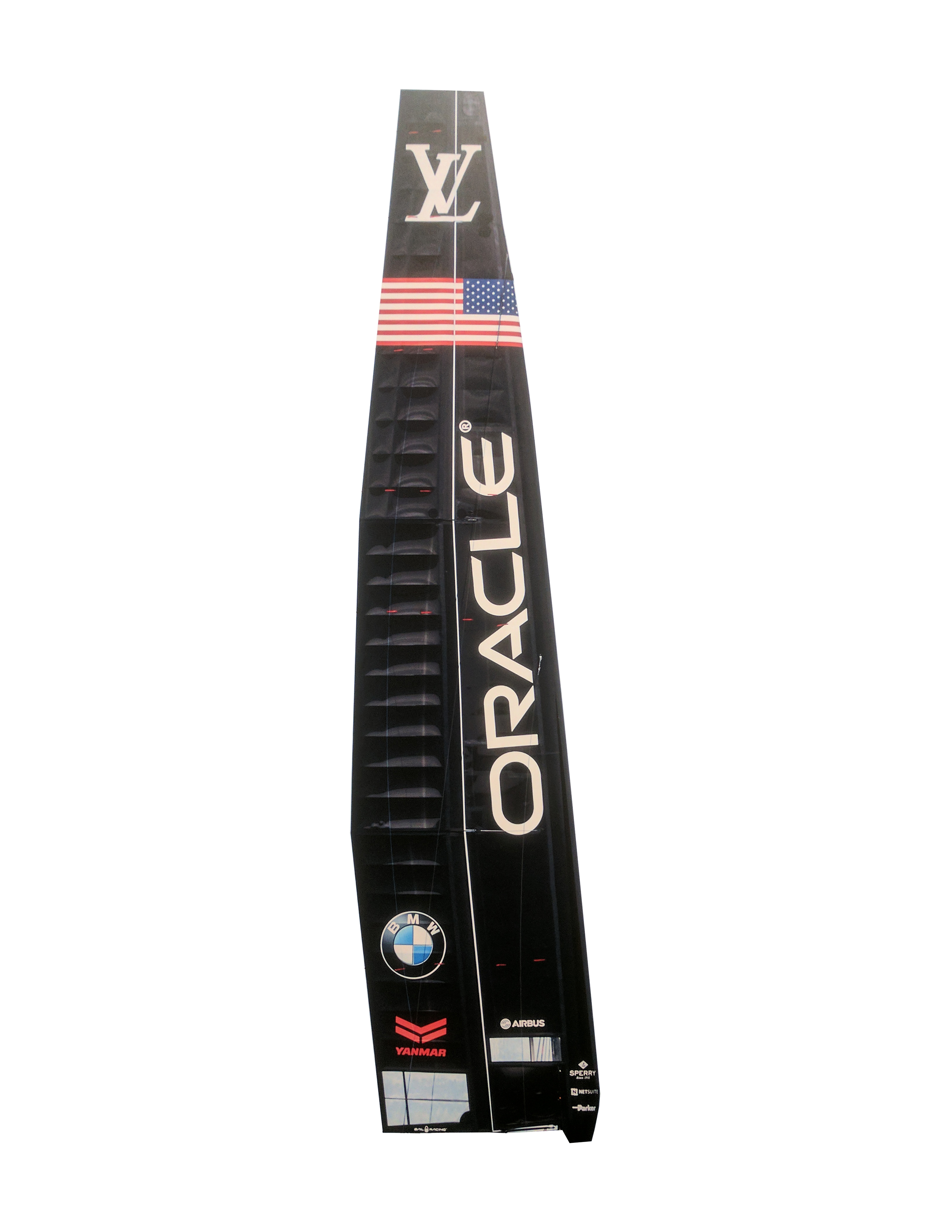
SHORT DESCRIPTION: Rigid wingsail for AC45S and AC45F hydrofoiling catamarans. An America's Cup component identification plate found on the lower spar and internal handwritten identification marks indicate that parts of the wingsail were originally used with the AC45F Oracle 4 and that it was certified on June 9, 2011. The wing is made up of six pieces: three main element pieces which include the thick, rigid carbon fiber leading edge (mast) and three trailing flaps. There are four control arms to maneuver the flaps. The main materials are carbon fiber, Clysar (outer covering), and titanium hardware. The frames have a paper/Nomex core. All of the internal control systems remain in place. The wing is roughly 75 feet tall and 17 feet in length (forward to aft). It is 2 feet wide at its base and 4-1/4 inches wide at the forward edge of the top of main element. Oracle Team USA's wingsails were built by Core Builders Composites in Warkworth, New Zealand. NOTES: Used by Oracle Team USA on its AC45F and AC45S catamarans. The AC45 served as the testing platform for the AC50 catamarans used in the 2017 America's Cup. While the component identification plate indicates the wingsail was originally built in 2011 it has undoubtedly undergone many modifications and has been recovered numerous times. At least three segments of the wing are marked "Oracle 4": the lower and upper main elements and the lower trailing element. INVENTORY: A-F Six (6) pieces: three forward (marked “Bottom ME”, “Upper ME” and one assigned name “Top ME” for the very top of the forward leading edge) and three trailing sections (marked F1, F2, F3); (ME=Main Element; F=Flap) A Wing leading edge section marked “Bottom ME” B Wing leading edge marked “Upper ME” C Wing leading edge,“Top ME” D Wing trailing edge, bottom, marked “F1” D1 Control arm (CA-1), attaches to bottom of F1 E Wing trailing edge, middle, marked “F2” E1 Control arm (CA-2), attaches to bottom of F2 F Wing trailing edge, top, marked “F3” F1 Control arm (CA-3), attaches to bottom of F3 F2 Control arm (CA-4), attaches to top of F3 G One (1) internal control arm linkage 26’2” long; diameter: 10mm; Marked: Carbo-Link 120086-792311 CA3 line 3 stbd Comment from Oracle rigger Jeff Causey regarding pieces G and H: The longer cables were originally internal control lines from the AC72 wing. They were probably re-appropriated to the AC45 test wing as CA4 internal control lines? H One (1) internal control arm linkage 26’2” long; diameter: 10mm; Marked: Carbo-Link 120086-792311 CA3 line 3 port I Wing sheet; Length: 27’3-1/2” Comment from Oracle rigger Dean Curtis: AC45S wing sheet, SK99 Dyneema core, 70/30% PBO/poly cover J Wing sheet; Length: 29’8” Comment from Oracle rigger Dean Curtis: AC45S wing sheet, SK99 Dyneema core, 70/30% Technora/poly cover K Wing sheet; Length: 33’2” Comment from Oracle rigger Dean Curtis: AC45S wing sheet, SK99 Dyneema core, 70//10/20% PBO/Dyneema/poly cover Unnumbered One (1) bag of titanium assembly hardware (inside 2017.15.02A) Unnumbered Three (3) dollies to transport wing
GERMANY - Manufacturer; BRISTOL - RHODE ISLAND - USA - Manufacturer; BERMUDA - Related Place
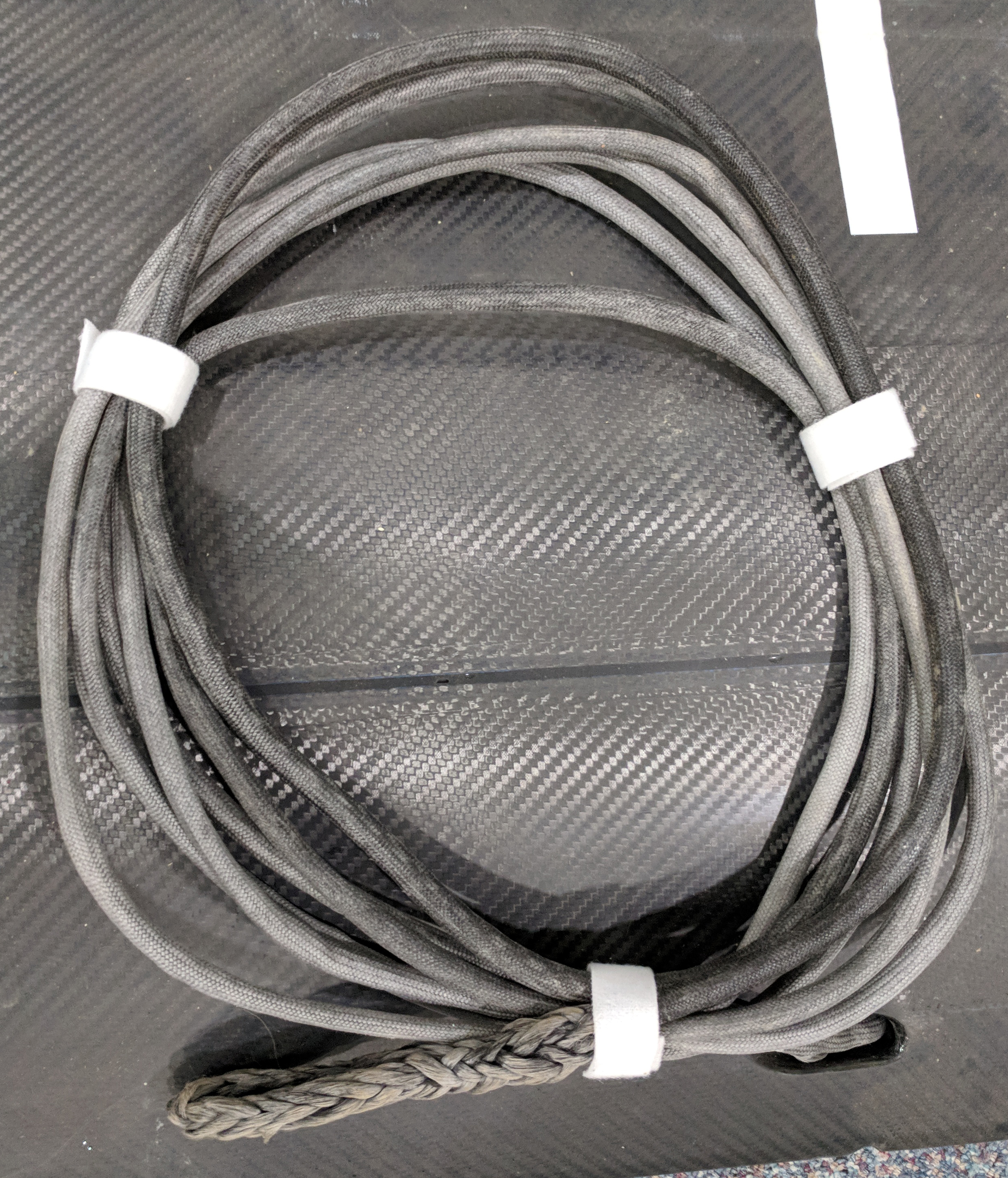
SHORT DESCRIPTION: Hydrofoiling daggerboard, Board 8, light air, starboard, with board downline (this is what rigger Jeff Causey called it) made of long pitch SK99 Dyneema core with x-wire Dyneema cover. Boards 8 was one of Oracle's “airplane wings” - the massive length of the wing and large amounts of camber on the trailing edge gave the board a lot of lift at low wind range. The daggerboard Used by Oracle Team USA as a test platform for the board designs that would be used with the AC50 in the 2017 America's Cup campaign. Apparently multiple companies were involved in the construction of the dagger boards. NOTES: Comments from Oracle Team USA boat builder Ben English regarding daggerboard 8: This is Board 8. What a battle horse. I think this board is comprised of over 75% of repairs along the shaft, not to mention the amount of work modifying the trailing edge. This board was a bit of a guinea pig. We pushed it to the max with different toe angles, different rake and cant ranges, and different trailing edges. Comments from Tom Speer, November 2018: I remember board 8 was a real breakthrough for us. It was built as large as the Design Rule would allow, and it showed that with a really long board, we could foil in light winds when our competition was stuck to the water and really clean up. Of course, it suffered once the wind came up because of the drag due to its wetted surface area and thickness. But it was an absolute killer in the right conditions. NOTES: Interview with Oracle Team USA boat builder Ben English about daggerboards given to Mariners': Jeanne Willoz-Egnor: What do the white triangles and lines indicate on the boards? Ben English: The white lines are ride height marks, and the white triangles are immersion marks. The ride height marks are measured out on the board’s surface, and act as an aid, for the sailors in controlling ride height. The white triangle immersion marks are meant to line up with the bottom of the boat. These immersion marks are more for the shore crew, to know that the up/down lines are attached properly and the board is where it belongs. Jeanne Willoz-Egnor: Are the yellow wires at the top of the daggerboards that are marked "inboard" and "outboard" stress sensors? Ben English: Yes, those wires belong to the fiber optics. You can see the groove the wires run through on the inboard and outboard sides of the board. Jeanne Willoz-Egnor: How much pressure do daggerboards have to withstand when the boat is foiling? Ben English: The amount of load put on these boards would change from modification to modification. They are built to withstand something like 5 to 6 tons of upload on the wing, probably an equal amount of download. Earlier boards could only handle about 3.5 to 4 tons on the wing, so we made some improvements structurally. The shaft for the most part saw side load while sailing, but not as much as one would think. The numbers for this were all over the place, depending how the boat was set up. Likely the shaft never saw more than a few tons. When we load tested the foils on our test bench, we would bend and stretch these foils at a few tons before we sailed to assure our numbers were accurate. Jeanne Willoz-Egnor: What is the date range on these boards? Were they all constructed between 2015 and 2017? Ben English: The last AC45 board was built in the late summer/fall of 2016. It would have been board 9, board 11 being the last completed board. Board 1 and 2 were actually built in 2014 and used on our initial boat 1 in San Francisco. Jeanne Willoz-Egnor: Were any of these boards used together? Ben English: All of these boards were used together at some point. The longer the wing, the better in light air. For looking authentic, board 8 could pair with board 11, or board 10 with board 11. For the most dramatic effect, board 8 and board 11 would be quite a sight. Jeanne Willoz-Egnor: Is there a standard nomenclature used for the different parts of a board? I know “shaft” and “leading and trailing edges”, but are there others? Do you use “wing” to refer to the foiling part or some other word? Ben English: You have all the major nomenclature listed correct. Wing is what we would call the foiling surface. On the rudder its called the wing or horizontal. I suppose you could add "chord" to your glossary. It’s the measurement of the foil surface from trailing edge to leading edge. Jeanne Willoz-Egnor: Are the light air boards the ones with the really long foils and heavy air boards the ones with the short foils? Or are some of the boards just considered general purpose for any wind condition? Ben English: Long wings are best in light wind because the area produces more lift in lighter conditions. This equates to more drag though, and slower performance up range. There are hundreds of different combinations to modify these boards to be optimal in one side of their range. For example, if you want your light air boards to do better in higher wind ranges, you modify the trailing edge to be smaller in chord (less area). If you’re looking for better take-off speeds in a heavy air board, you add camber to the trailing edge for more lift. If we had any board that could be considered all purpose, it would be board 10, but we called it light air, mostly because we geared the board towards light air. Jeanne Willoz-Egnor: What the approximate usable wind ranges were for our boards? Ben English: The wind ranges for daggerboards were classified as such- Light air-6 to 10 knots Mid-range or A.P board-8 to 12(A.P. stood for all purpose. It always seemed to be either light breeze or heavy in Bermuda now that I think about it) Heavy air-12 to 20 Generally speaking, the less wetted surface, the less drag, and the more speed: Boards 7 and 9 are heavier air, high speed boards. Board 3 was an earlier, all-purpose board. Very stable, easy to sail board, until it unzippered itself. Board 10 could also be lumped into the mid-range wind speed, but was heavily modified to suit either its all-purpose use or heavier air use. Boards 8 and 10 were our “airplane wings”. The massive length of the wing and large amounts of camber on the trailing edge gave it a lot of lift at low wind range. Because the boards are so expensive and time consuming to produce, all of these boards were heavily modified to either move their efficiency up or down the wind range, depending on how the sailing team and designers saw fit. Jeanne Willoz-Egnor: Exactly what is “toe angle”? Ben English: The toe angle is what angle of attack the centerline of the leading edge is. This is in relation to an imaginary centerline called yawl. Different toe angles would change the performance of how the board goes through the water. Too extreme an angle in either direction can put a lot of load on the board in a dangerous way, so it's a bit of trial and error I suppose. Jeanne Willoz-Egnor: If I understand correctly, the daggerboard number refers to a particular design not the number of boards produced. Ben English: Yes, there were times we would be finishing off building a lower denomination number board, and putting a higher denomination board of the same side in the boat before it. Jeanne Willoz-Egnor: Are the boards essentially experimental and once a design was perfected a new board was made for use on the AC50? Or were these boards swapped around and used on both the 45 and the 50? Ben English: We could have used some AC45 boards in the AC50, but we never did. It would have been a bit of work swapping bearings around to match AC45 boards. The AC50 boards were born from all the different designs of the AC45 boards. The best of traits of the AC45 boards would go to the AC50 board program. We had to be careful choosing, as we were only allowed to have four boards for the AC50. NOTES: The information about the drop line was provided by OTUSA riggers Jeff Causey and Dean Curtis.
SHORT DESCRIPTION: This accession is for a sample of relish. The relish is stored in a clear, modern glass sample container with a black plastic lid. The container is encased in clear Lucite. NOTES: The sample of pickle relish came from a jar of relish recovered intact from an excavation in the area of the captains cabin in 1979. The relish was in a jar with a glass lid, rubber gasket and wax seal. The lid of the jar is marked "Hartell's Glass Air-Tight Cover." Research in the records of the US patent office reveals that Hartell had patented his air-tight design in 1858. Analysis of the relish indicated that it contained cloves, onions, pepper seeds, cucumbers, mustard seeds, peppercorns and mushrooms. [Dina Hill and Jeff Johnston, NOAA, March 8, 2000] NOTES: Upon further research it is now believed that the relish which is now encased in Lucite is originally from MNMS.1990.001.019. 11/24/2015 MS
SHORT DESCRIPTION: This accession is for a sample of relish. The relish is stored in a clear, modern glass sample container with a black plastic lid. The container is encased in clear Lucite. NOTES: The sample of pickle relish came from a jar of relish recovered intact from an excavation in the area of the captains cabin in 1979. The relish was in a jar with a glass lid, rubber gasket and wax seal. The lid of the jar is marked "Hartell's Glass Air-Tight Cover." Research in the records of the US patent office reveals that Hartell had patented his air-tight design in 1858. Analysis of the relish indicated that it contained cloves, onions, pepper seeds, cucumbers, mustard seeds, peppercorns and mushrooms. [Dina Hill and Jeff Johnston, NOAA, March 8, 2000] NOTES: Upon further research it is now believed that the relish which is now encased in Lucite is originally from MNMS.1990.001.019. 11/24/2015 MS
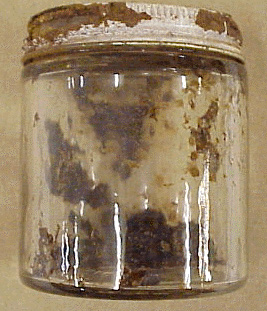
SHORT DESCRIPTION: This accession is a glass jar with a metal cap containing relish. The relish is decomposed and the metal top suffers from corrosion. NOTES: The sample of pickle relish came from a jar of relish recovered intact from an excavation in the area of the captain’s cabin in 1979. The relish was in a jar with a glass lid, rubber gasket and wax seal. The lid of the jar is marked "Hartell's Glass Air-Tight Cover." Research in the records of the US patent office reveals that Hartell had patented his air-tight design in 1858. Analysis of the relish indicated that it contained cloves, onions, pepper seeds, cucumbers, mustard seeds, peppercorns and mushrooms. [Dina Hill and Jeff Johnston, NOAA, March 8, 2000] NOTES: Upon further research it is now believed that the remaining relish in this modern jar is originally from MNMS.1990.001.019. 11/24/2015 MS
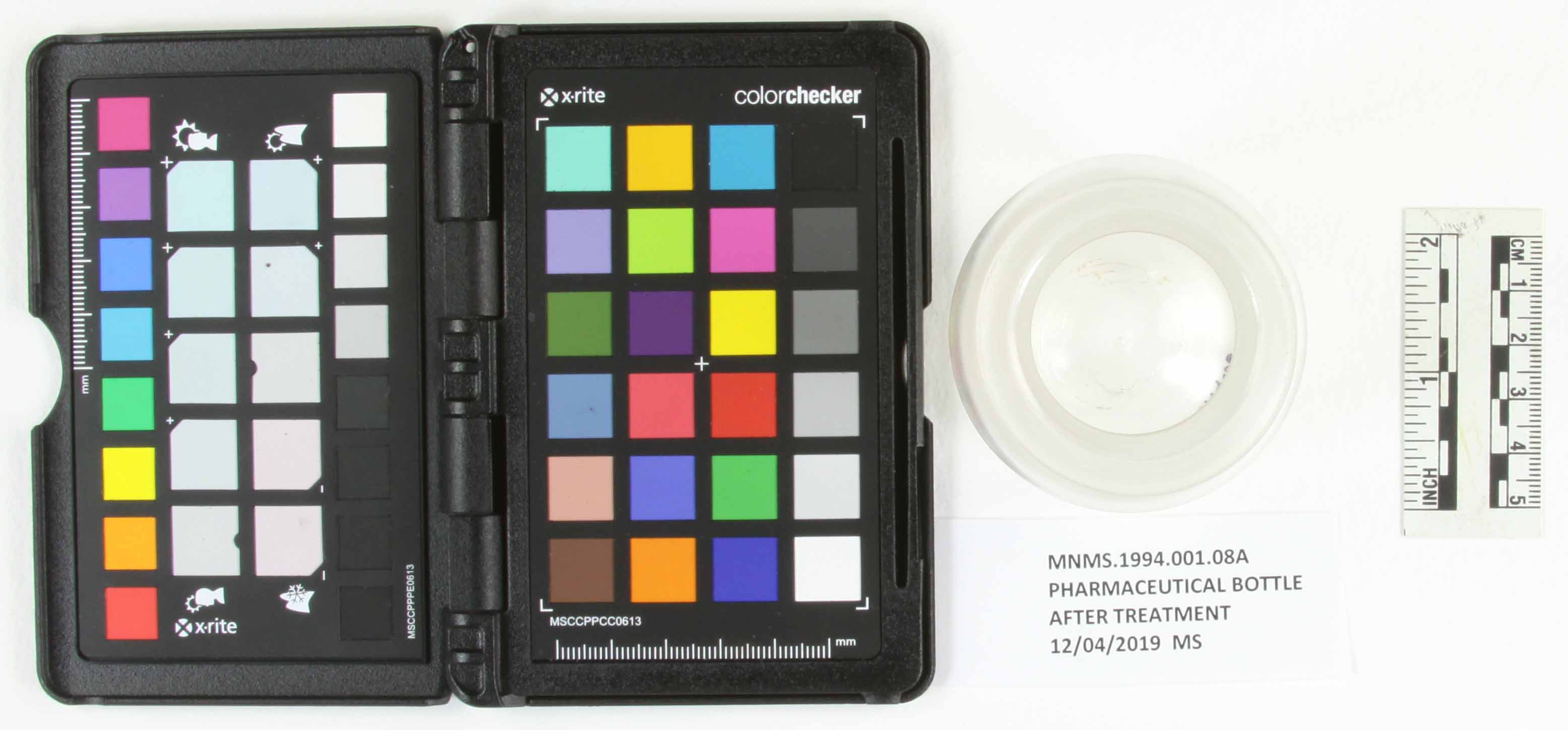
AFTER TREATMENT DESCRIPTION: This accession is a pharmaceutical bottle. The object was recovered from the wreck site of the USS Monitor. The object is made of clear glass. After treatment the object is free of all debris and staining and is in excellent condition. This object is a glass bottle, round without a stopper. The glass is clear in color but hazy due to light scrapes and scratches throughout the surface. The bottle is tubular in shape at the bottom then sharply goes inward to a thinner neck which gradually flares out to a thick lip. COMPONENT PARTS: B. CONTENTS PROVENIENCE: USS MONITOR WRECK SITE NOTES: The pharmaceutical bottle was recovered in 1994 from an area of the MONITOR that may have been a store room used by the MONITOR;'s surgeon. This is one of several small medicinal bottles recovered from the area. [Dina Hill and Jeff Johnston, NOAA, March 8, 2000]
SHORT DESCRIPTION: This accession is for a sample of relish. The relish is stored in a clear, modern glass sample container with a black plastic lid. The container is encased in clear Lucite. NOTES: The sample of pickle relish came from a jar of relish recovered intact from an excavation in the area of the captains cabin in 1979. The relish was in a jar with a glass lid, rubber gasket and wax seal. The lid of the jar is marked "Hartell's Glass Air-Tight Cover." Research in the records of the US patent office reveals that Hartell had patented his air-tight design in 1858. Analysis of the relish indicated that it contained cloves, onions, pepper seeds, cucumbers, mustard seeds, peppercorns and mushrooms. [Dina Hill and Jeff Johnston, NOAA, March 8, 2000] NOTES: Upon further research it is now believed that the relish which is now encased in Lucite is originally from MNMS.1990.001.019. 11/24/2015 MS
AFTER TREATMENT DESCRIPTION: This accession is a sample of relish. The relish is stored in a clear, modern glass sample container with a black plastic lid. The container is encased in clear Lucite. NOTES: The sample of pickle relish came from a jar of relish recovered intact from an excavation in the area of the captain’s cabin in 1979. The relish was in a jar with a glass lid, rubber gasket and wax seal. The lid of the jar is marked "Hartell's Glass Air-Tight Cover." Research in the records of the US patent office reveals that Hartell had patented his air-tight design in 1858. Analysis of the relish indicated that it contained cloves, onions, pepper seeds, cucumbers, mustard seeds, peppercorns and mushrooms. [Dina Hill and Jeff Johnston, NOAA, March 8, 2000] PROVENIENCE: USS MONITOR WRECK SITE NOTES: Upon further research it is now believed that the relish which is now encased in Lucite is originally from MNMS.1990.001.019. 11/24/2015 MS
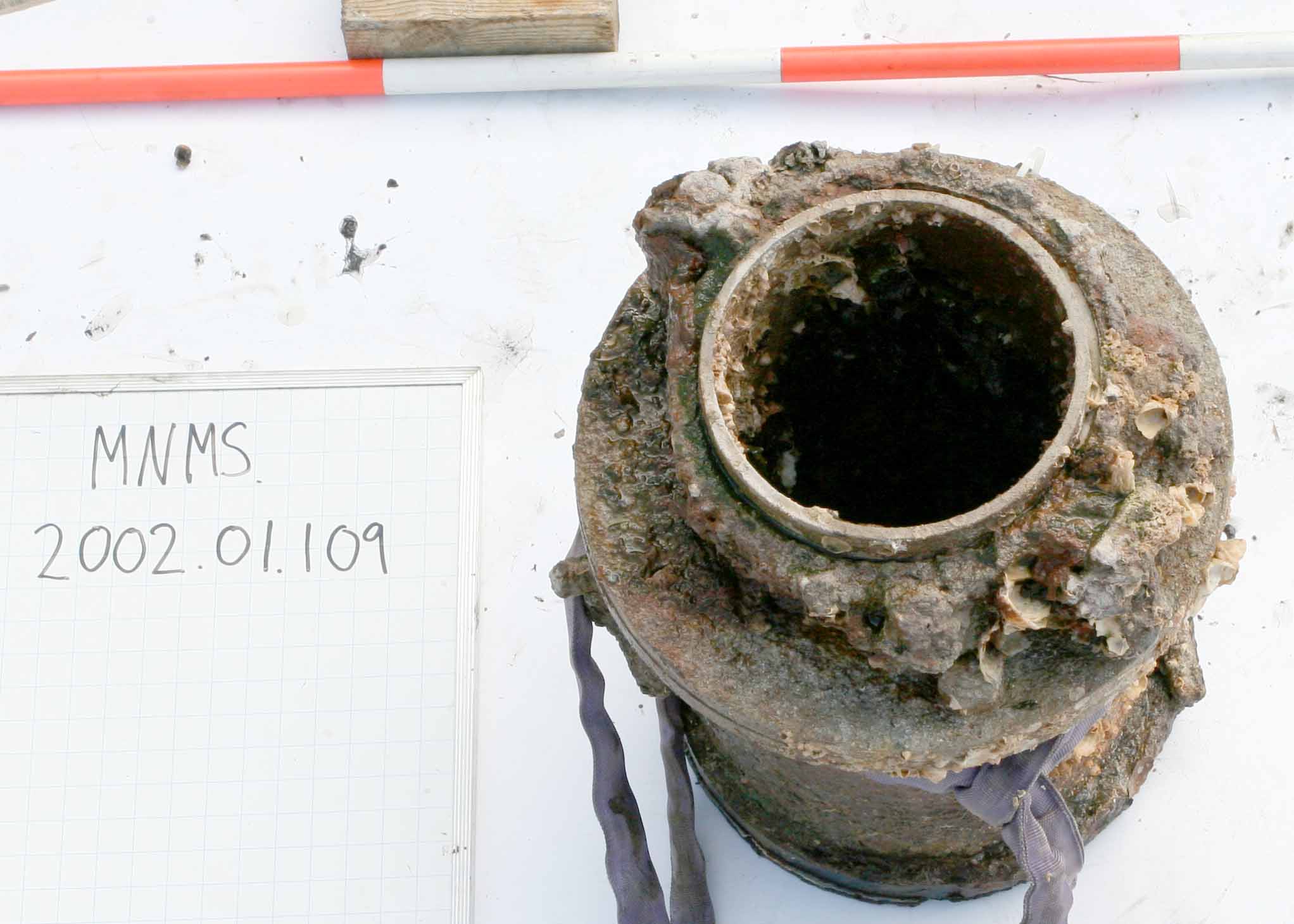
BEFORE TREATMENT DESCRIPTION: This accession is a large pipe with valve pieces attached to the sides of the center section. On one end is a flange, measuring 14-1/4"(outside diameter) and 8-7/16"(inside diameter). On the other end, a piece smaller in diameter than the center section appears and on the end a larger piece is bolted on, measuring 9-1/4"(outside diameter) and 8-7/16"(inside diameter) on the end. NOTES: From near officer's quarters. Large pipe/valve from the area of ship where officer's head would be. NOTES: 02/05/2009 Believed to be a component of one of the below waterline flushing toilets. First observed/documented and tentatively identified in the wreck by Jeff Johnston in 1998. This was supposed to be the component recovered and brought back as "the toilet" in 1999. A mix up on the bottom led to the wrong component (gate valve) being recovered instead. Background: The USS Monitor's designer incorporated four below waterline flushing toilets into the vessels design. 1. Captain's Head: 1- Located cabin on the starboard side of the vessel. 2. Crew Head: 2- Located aft of the midships bulkhead, starboard side adjacent to galley. 3. Officer's Head: 1- Located aft of midships bulkhead, port side adjacent to galley. Artifact Identification: Through hull fitting. Artifact was mapped and compared with historic plan information. Location was within two feet of where historic plans showed a single water closet. Piece originally had remnants of hull plating attached. During the 2002 turret recovery expedition flange was observed on its side lying in the wreck separate from any hull plating. Recovered in August 2002 and tentatively id'd as large flanged pipe since folks were a little gun shy after the earlier toilet SNAFU. JJ MNMS COMPONENT PARTS: A02. GASKET A03. IRON STRAP A04. IRON STRAP A05. STRAP BOLT A06. STRAP BOLT A07. BOLT A08. BOLT
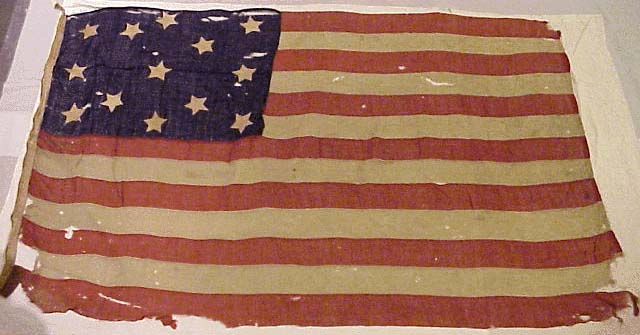
SHORT DESCRIPTION: 13-star American flag approximately 9'4" (length) x 6' (width). The fly end of the flag has been extensively repaired so the total length of the flag is most likely shorter than when originally constructed. There are seven red stripes (wool, likely dyed with madder or cochineal) and six white (wool, undyed), each about 5-1/4" wide. Red stripes are on the outer edges of the flag and the blue canton (wool, dyed with Prussian blue-confirmed using ATR-FTIR) sits on a red stripe. The stripes are sewed together with flat-felled seams. The blue field is composed of two strips of cloth about 17" wide sewed together x 47" long sewed together with flat-felled seams. The stars are irregularly shaped and sewn onto both sides of the blue field in a pattern of 3-2-3-2-3. The entire flag is hand stitched, including the numerous repairs. The selvage edges appear to be hand loomed. The heading is made of a heavier, plain weave fabric made of linen or hemp. There are no grommets, the rope (linen or hemp) is encased inside the heading and bent and stitched to the exterior of the heading piece. The rope ends in a loop at the top and at the bottom has been cut and the ends are seized together. Parts of the rope have a black substance on them that may be pitch or tar. The bottom of the flag exhibits extensive wear which may be the reason for such a small loop at the bottom of the hoist. There is a patch of different material at the bottom of the hoist that reconnects the bottom red stripe to the hoist. The fly end appears to have been extensively repaired and possibly shortened. The stripes at the fly end are of varying widths depending upon how extensive the repairs were. On the header there are a set of initials, "A.C.L." The angle of the hand during writing gives the appearance of changing line thickness which which indicates the letters may have been applied with a flat, split-knib pen, quill or reed. The separation of the line in the curve of the "C" indicates it is a split nib. This type of nib is fairly ubiquitous, so it is hard to draw any sort of dating information from it. Unfortunately, this type of nib is fairly ubiquitous, so it is hard to draw any sort of dating information from it. NOTES: [Howard Kanare, March 21, 2022] The flag looks like the work of someone who followed the conventions of sailmaking. The rope is attached with a round stitch which is how a sailmaker would sew on a bolt rope. Stitching with double strands is standard practice for ropework on ships. Stitching through valleys of rope, with stitches uniform in size and angle, is also standard practice for ropework on ships. Straight stitches also typical of sailmaker. Running stitch next to flag fabric is not overly twisted, which means someone was intentionally trying to keep the yarns flat as they stitched–another common attribute of a sailmaker. Near the “C” in the initials there is a join between two pieces twine which is made the way a sailmaker would do it (i.e. not tied with a knot but with the yarns twisted together along the length to create one continuous piece of line). The seizings were very definitely made by a sailmaker. They are all done the same way and are very nicely. The eyesplices are typical of a sailmaker’s work. All of the attributes are very consistent with a nautical origin. This was probably made by someone with quite a bit of sailmaking experience, who was trained and worked with precision. NOTES: In a letter dated May 5, 1959, Julian R. Powell of U.S. Navy Recruiting Station in Richmond, Virginia, wrote the following about this object: "During my talks with Mr. Burgess, I informed him of the existence of a flag in Richmond, which may be one of the original ensigns of the United States Navy [we don't believe that this is true]. The Flag is 9 1/2 feet by 6 feet, and has 13 stars in alternating rows of 2&3 stars respectively. At one time there were documents with the flag telling of its history, but they along with the sea chest in which they were contained were destroyed several years ago in a fire in Martha's Vineyard off the New England Coast." The donor was originally from Massachusetts. [Willoz-Egnor, April 2022] Vexillologist Jeff Bridgman feels the date of the flag is pre-civil war or earlier, and tentatively dates the flag as late 1830s to 1850s. He bases this purely on his experience with flags (has handled more than 800) not on any scientific study of materials. He states the star pattern is peculiar as the 3-2-3-2-3 pattern didn’t appear on the Navy’s books until the 1850s (this is contradicted by Grace Rodgers Cooper; and the 1814 Fort McHenry flag clearly shows the 3-2-3-2-3 pattern with two additional stars). He feels the bolt rope places the flag earlier in the date range. He commented that the “blood stripe” is not a common attribute and definitely feels this flag is nautical in origin. NOTES: [Excerpts from Sundry Devices, Drawings, Mottos &cs for the Public Use: The Fancy-work of F. Hopkinson, by David B. Martucci, published in NAVA News, Vol. 34. No. 3, July-September 2001, Issue #171, pages 4-11] Francis Hopkinson, a Revolutionary War era lawyer and merchant, member of the Continental Congress and employee of the same body and later of the Federal Government, is believed to have designed the United States flag, based on his own claims. Four contemporary documents (bills for his work to the Continental Congress) in Hopkinson's own hand and signed by him, show his claim to having been the designer of the United States flag, among other items. He describes it in four ways, "the Flag of the United States of America," "the great Naval Flag of the United States," "the Naval Flag of the United States," and "the Naval Flag of the States." Hopkins was chairman of the Navy Board of the Marine Committee. No one at the time denied he did any of the work he claimed. Hopkinson's bills to the Continental Congress refer to the Stars and Stripes in basically two ways, with three of the four bills submitted making reference to it being a "naval" flag. There is a long-held theory that the U.S. Flag was originally intended to be a marine flag. We have no documentation on what exact design (if any) Hopkinson had in mind for the flag. It seems obvious to this writer that Hopkinson had NO particular design for the stars in the US Flag in mind on June 14, 1777. Any "constellation" of stars would do, whether in a circle, in rows or in any other haphazard fashion, as long as it was clearly a "new constellation." NOTES: According to Grace Rodgers Cooper's 1973 publication Thirteen-Star Flags: Keys to Identification, the earliest use of the 3-2-3-2-3 arrangement of 5-pointed stars with red and white stripes is 1783. She also refers to the 1914 publication by Peleg Harrison titled "The Stars and Stripes and Other American Flags..." which states "In 1835, and for many years after, ensigns were made at the Norfolk navy yard for all vessels of war equipped at that station. In these flags, the canton rested on a red stripe, as it invariably did in the fifteen-stripe flag in use from May 1, 1795, to July 4, 1818, while in all aother thirteen-stripe standards the blue field rested on a white stripe. On account of this peculiarity, these flags were called by signal quartermasters "Norfolk war flags," because the canton rested on a red stripe, red being an emblem of war." Unfortunately, Mr. Harrison provides no attribution for this information.
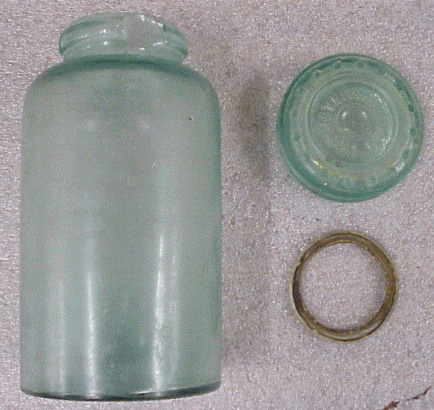
AFTER TREATMENT DESCRIPTION: This accession is a large glass jar. This object was recovered from the USS Monitor wreck site. After treatment the object is free of all debris and staining and considered to be in excellent condition. The glass the jar is made of is thick and clear with a slight green tint in color. The surface is scratched and dull with some slight patina at the rim which also contains stress cracks and a chip. There is a crack around the base. The lid is also thick green tinted glass with some patina around the inside where it contacted with the jar rim. The lid contains stress cracks on top and inside with chips on the base of the rim. The seal is in poor condition as it is desiccated and warped with surface residue present. NOAA INV. #: 106 NOTES: The samples of pickle relish in the NOAA collection came from a jar of relish recovered intact from an excavation in the area of the captain’s cabin in 1979. The relish was in a jar with a glass lid, rubber gasket and wax seal. The lid of the jar is marked "Hartell's Glass Air-Tight Cover." Research in the records of the US patent office reveals that Hartell had patented his air-tight design in 1858. Analysis of the relish indicated that it contained cloves, onions, pepper seeds, cucumbers, mustard seeds, peppercorns and mushrooms. [Dina Hill and Jeff Johnston, NOAA, March 8, 2000] COMPONENT PARTS: B. LID C. RUBBER SEAL PROVENIENCE: USS MONITOR WRECK SITE NOTES: Upon further research it is now believed that this jar contained the relish which is now encased in several blocks of Lucite numbered; MNMS.1990.001.088 – MNMS.1990.001.092. 11/24/2015 MS
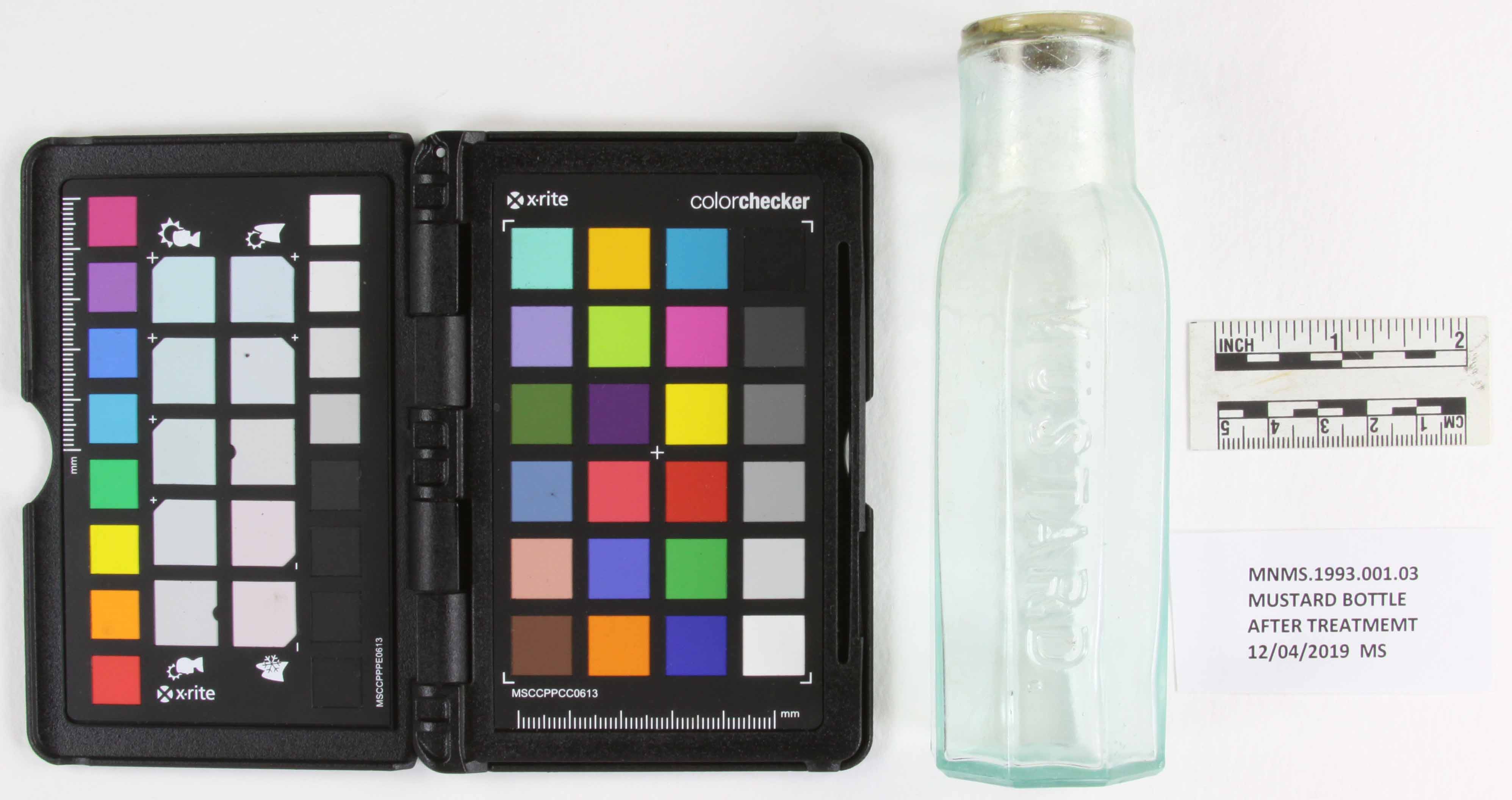
AFTER TREATMENT DESCRIPTION: This accession is a condiment bottle. The object was recovered from the wreck site of the USS Monitor. The light green glass two-piece molded storage bottle is 5-1/2" in height. The body is molded to form an octagon 1-11/16" in diameter across embossed flats that measure between 11/16" and 3/4" in width. At a height of 3-3/4" above the base, the body turns in to form a rounded octagonal shoulder below the base of a 1-3/8" diameter round cork neck. The 1-1/4" long neck terminates in an interior rolled collar. Two opposing flats, one in each mold half, are embosses "U.S. NAVY" and "MUSTARD" in 3/8" high letters. This bottle has a dark colored stain around the upper lip. After treatment the object is free of all ocean debris and considered to be in good condition. NOTES: This mustard bottle is one of several recovered in 1993 and one of approximately 20 recovered since 1979. Similar bottles embossed with "US NAVY" and "PEPPER" have also been recovered. Most of these bottles have been recovered from an area of the ship that was apparently used for gallery stores. The ratio of mustard to pepper bottles is about 5:1. This is probably because the pepper jars contained pepper corns which were crushed and used as needed. The abundance of mustard jars indicates that not unlike today's MREs, which each contain a small bottle of hot sauce, military foods tends to lack flavor and the officers and crew of the MONITOR (as well as other Navy vessels) used an abundance of mustard to add flavor to unflavorful rations and to cover up the taste of tainted rations. [Dina Hill and Jeff Johnston, NOAA, March 8, 2000]
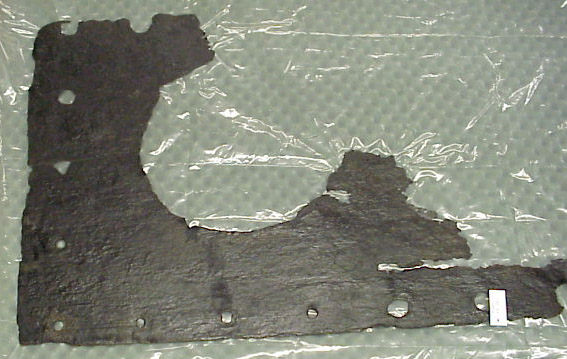
BEFORE RE-TREATMENT DESCRIPTION: This accession is a wrought iron plate recovered from the USS Monitor around the propeller shaft. The object maintains two edges of a rectangular plate. There is a partial 19” diameter cut out near the center. The longest remaining edge contains seven fastener holes. One of the holes is partial as they increase in diameter due to deterioration the farther they are from the corner. The shorter edge maintains five fastener holes. One of the holes is partial as they increase in diameter due to deterioration the farther they are from the corner. A small portion of the second longer side remains with two partial fastener holes. This object maintains no original surface due to severe deterioration creating a rough, uneven texture and appearance throughout. All edges are jagged and uneven. The object is black in color with dark red undertones and small areas of active corrosion. The object is considered to be in fair condition. NOTES: The large plate was recovered during an expedition with the US NAVY in June 1998. The circular opening in the plate is believed to have been an access hatch for one of the tiller sheaves. This plate was recovered from under the stern area of the wreck on the starboard side. There is an open hole in the deck just above the area where this plate was recovered, but divers have been unable to see inside. [Dina Hill and Jeff Johnston, NOAA, March 8, 2000]
JAPAN - Manufacturer; PEARL HARBOR - HAWAII - UNITED STATES - Related Place
SHORT DESCRIPTION: Type 92 periscope made by the Japan Optical Engineering Company (Nippon Kogaku Kogyo Kabushiki Kaisha) from the two-man submarine HA.19 (Haramaki 19). Manufactured in 1940-1941 and installed on the submarine in May. The periscope was removed by the US Navy after the submarine's capture on December 8, 1941. The periscope has two magnifications 1.5x and 6.0x. A memo dated December 26, 1941 from the Commander Submarine Squadron Four to the Chief of Naval Operations provides detailed information regarding the periscope from the captured submarine. According to the document the periscope had a manufacturing plate with the following information (translated from Japanese): Type 92 periscope., # 18., By plan of Naval Technical Laboratory., Made by Japan Optical Manufacturing Company. May 1941. The report states the periscope is 10' long, 3-⅝” diameter, “Japanese make, but almost an exact copy of our Zeiss 30' periscope, two magnifications 1.5 and 6.0, raised and lowered by electric motor.” NOTES: Notes from Hans Braakhuis' 'The History of Nippon Kogaku 1600-1949' and Jeff Alexander's 'Nikon and the Sponsorship of Japan's Optical Industry by the Imperial Japanese Navy, 1923-1945': Nippon Kogaku produced its first periscope in 1918 and improved its design during the 1930s. Following World War I Nippon Kogaku based most of its early optical engineering projects on German designs. In January 1921 five German technicians arrived in Tokyo and began introducing German designes and manufacturing processes to Nippon Kogaku's production line, giving the company a development pattern that paralleled the German optical firms of Leitz and Zeiss. Between 1920 and 1922 fifty to 60 periscopes were manufactured. At the beginning of the Showa period large numbers of 9 and 10 meter periscopes were being produced. Added to these models was a series of smaller periscopes for use aboard the navy's kaiten (midget submarines). Nippon Kogaku was tasked by the Imperial Japanese Navy to make working periscopes for over 300 midget submarines. NOTES: Information from the National Register of Historic Places Registration Form: Five Type A Kō-hyōteki (甲標的) class midget submarines participated in the raid on Pearl Harbor on December 7, 1941. The small submarines were transported on five I-class fleet submarines sitting directly aft of the conning tower and attached to the deck with steel belts. They were launched near the entrance to Pearl Harbor just before the attack was to begin. Their mission was to slip into Pearl Harbor, wait until the attack, and then launch their two torpedoes. They would then navigate submerged, around Ford Island to meet up with their mother sub approximately seven miles west of Lanai. HA.19 was the last of the five small submarines to launch. It was launched from the deck of the I-24 at 3:33 am about 10-½ miles off Pearl Harbor. Before its launch, the submarine’s pilot, Ensign Kazuo Sakamaki, learned that the subs gyro compass was not functioning. Despite the problem, Sakamaki was determined to proceed with his mission. After launching the submarine suffered with trim problems forcing the two crew to shift ballast around to prevent the vessel from sinking. The sub successfully navigated Pearl Harbor’s entrance, but the crew had to fight to keep the sub from surfacing and were forced to navigate in circles because of the malfunctioning gyro compass. The harbor entrance was reached at 7:00 AM. Running at periscope depth, Sakamaki managed to navigate the entrance without being spotted by aircraft, but could not make the harbor before the Japanese air attack commenced. HA.19 struck submerged coral reefs at the entrance three times. Sakamaki surfaced just after 8:00 AM. It was in that location, aground with propellers spinning in reverse, that HA.19 was spotted by the USS Helm. The shots fired by Helm missed but blasted the submarine off the reef, disabling one of the torpedo firing mechanisms and knocking Sakamaki unconscious. Upon regaining consciousness, Sakamaki saw the devastation in Pearl Harbor and pressed forward only to run aground again. The sub successfully backed off the reef and headed for the harbor only to run aground again. Attempts to back off the reef failed which forced Sakamaki and Chief Warrant officer Kiyoshi Inagaki to shift ballast again. The sub was damaged, partially flooded, filled with smoke and fumes and when freed from the reef the crew discovered the sub would not answer its helm. HA.19 was depth charged several times as it drifted through Pearl Harbor’s defensive zone. The sub drifted to the east coast of Oahu and grounded on a reef off Bellows Field, Waimanalo, Oahu. Sakamaki ordered Inagaki to abandon ship and attempted to scuttle the submarine with explosives before jumping into the surf. The two crew were separated in the surf and the charges meant to destroy the submarine did not explode. Sakamaki lost consciousness and woke up on the beach on December 8th with Sgt David Akui standing guard over him. Inagaki's body washed ashore the next day. Ensign Kazuo Sakamaki was the United States' first prisoner of World War II. HA.19 was the only Japanese vessel captured intact from the December 7th attack. HA.19 was hauled ashore, dismantled and exhaustively documented. The sub was designated "Midget C" by the United States Navy according to the order in which the U.S. encountered them. The vessel was then reassembled, with the periscope, motor, ballast, batteries, armament and most of the equipment and shipped to the mainland in January 1942. There it was mounted on a trailer, and modified for public display. It was then toured throughout the United States between 1942 and 1945 to raise money for war bonds. In January 1947 the submarine was sent to the Submarine Base in Key West, Florida for outdoor display. In 1964 it was loaned to the Key West Art and Historical Association for display. In 1991 the submarine was moved to the National Museum of the Pacific War at the Admiral Nimitz State Historic Site in Fredericksburg, Texas. [See the attached NRHP Registration form for additional historic information] INVENTORY: Parts - there is one (1) component part.

 Catalogue
 Full-size image
 MS0385-02.014_01
 P0003-01 - J-12130
 P0003-01 - J-12132
 MS0336-2-1.15-2_01
 MS0336-02-02-02.10-02_01
 MS0455.002
 P0003-01 - J-12133
 MS0336-2-1.16-3_01
 P0003-01 - J-12131
 Full-size image
 MS0336-02-02-02.11-03_01
 PP1824JawesJawesWalters
 MS0336-2-1.09-1_01
 MS0336-02-02-02.03-10_01
 P0003-01 - E-16019
 MS0336-2-1.08-10_01
 MS0336-02-02-02.04-01_01
 Full-size image
 Full-size image
 2020.0005.000010_01[1]
 Full-size image
 2020.0005.000024_01[1]
 Full-size image
 Full-size image
 17-15-02Wing
 Drop line
 Full-size image
 Full-size image
 Full-size image
 mnms 1994-01-08A AT1
 Full-size image
 Full-size image
 A BT1
 Full-size image
 A-C AT1
 mnms 1993-01-03 AT1
 Full-size image
 NT52A